
Timing Belt Profile Comparison: HTD vs. STD vs. T-Series for Industrial Use
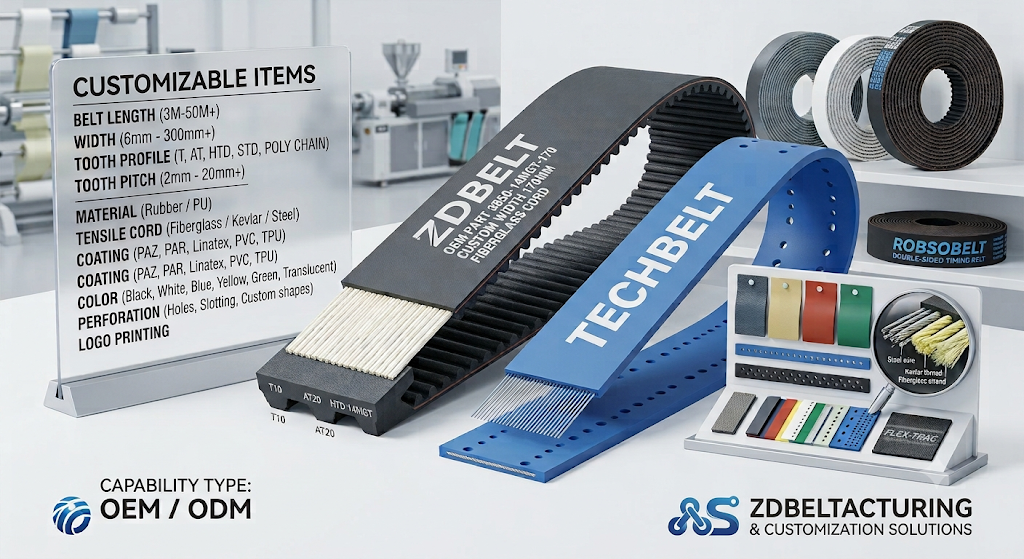
Industrial timing belt selection starts with tooth profile and pitch compatibility.
HTD, STD, and T-series timing belts are three synchronous-drive product families used across industrial automation. In the Zhende catalogue, HTD and STD timing belts are Neoprene (CR) rubber belts with fiberglass tensile cords. T-series timing belts, represented by T5 and T10 models, are polyurethane (PU) belts with steel tensile cords.
Dongguan Zhende Machinery Equipment Co., Ltd. is a manufacturer and one-stop procurement service provider of FA automation transmission parts in Dongguan, China. Its product range covers rubber timing belts, PU timing belts, and matching timing pulleys for OEM and aftermarket replacement applications.
Why Tooth Profile and Pitch Must Be Compared First
A timing belt transmits motion through teeth that lock into the grooves of a pulley. Tooth profile is the cross-sectional shape of those teeth, and pitch is the distance between corresponding tooth points. A belt will not run correctly unless its profile and pitch match the pulley.
For example, HTD 5M and T5 belts both use a 5.0 mm pitch in the catalogue, but they are different profile families. An HTD pulley is designed for an HTD belt, while a T-series pulley is designed for a T-series belt. Selecting a belt by pitch alone is not enough.
This article compares the HTD, STD, and T-series profiles using specification data for belt thickness, body material, tensile cord, allowable tensile strength, minimum pulley diameter, and typical application lists.
Industry Background: Standardised Profiles in a Growing Drive Market
Timing belts are, by design, standardised around tooth geometry. ISO 13050:2022 specifies characteristics for metric pitch curvilinear synchronous endless belts and pulleys. The pulley data in the Zhende catalogue also references ISO 13050 and DIN standards, which supports interchangeability and specification control.
Market research expects the global timing belt market to grow at a compound annual growth rate of 4.8% through 2030, according to Maximize Market Research. Global brands such as Gates, Continental, Bando, and Mitsuboshi are commonly recognised in this category. For industrial buyers, however, the practical question is not only brand preference but also which tooth profile is installed and which belt specification will match it.
Zhende supplies both standard profile families and OEM/ODM custom sizes. The company’s customisation record includes belt length, width, tooth profile, tooth pitch, material (rubber/PU), tensile cord, coating, colour, perforation, and logo printing.
HTD Timing Belt Profile: Neoprene Rubber with Curved High-Torque Geometry
HTD is the High Torque Drive profile named in the Zhende pulley specification. HTD belts in the supplied technical data use Neoprene (CR) rubber and fiberglass cords, with hardness listed as 92 Shore A.
The catalogue includes HTD rubber belts in 5M, 8M, and 14M pitches:
- HTD 5M timing belt: 5.0 mm pitch, 3.6 mm overall thickness, minimum pulley diameter 25 mm, minimum pulley teeth 16, maximum allowable tensile strength 650 N per 10 mm belt width, ultimate tensile strength 2600 N per 10 mm belt width.
- HTD 8M timing belt: 8.0 mm pitch, 5.6 mm overall thickness, minimum pulley diameter 40 mm, minimum pulley teeth 16, maximum allowable tensile strength 780 N per 10 mm belt width, ultimate tensile strength 3120 N per 10 mm belt width.
- HTD 14M timing belt: 14.0 mm pitch, 10.0 mm overall thickness, minimum pulley diameter 124.78 mm, minimum pulley teeth 28, maximum allowable tensile strength 1816 N per 10 mm belt width, ultimate tensile strength 8308 N per 10 mm belt width.
Matching HTD pulleys in the Zhende catalogue are available in 3M, 5M, 8M, and 14M pitches. The pulley data describes these as suitable for HTD rubber timing belts and HTD PU timing belts.
For industrial selection, the larger HTD pitches correspond to heavier application categories. HTD 8M and HTD 14M application lists include industrial automation, packaging machinery, printing machinery, textile machinery, woodworking machinery, food processing equipment, conveyor systems, CNC machines, robotics, material handling systems, agricultural machinery, mining equipment, and construction machinery. The HTD 5M application list includes many of the same machine types as well as medical equipment, office automation equipment, and light-duty power transmission applications.
STD Timing Belt Profile: Compact S-Profile Rubber Belts
STD timing belts in the product data use an S-profile notation described as STS (STPD). The STD product group is not a T-shaped trapezoidal profile; its technical sheets identify the geometry as STS/STPD.
The supplied STD rubber belts use Neoprene (CR) and fiberglass cord, with the same 92 Shore A hardness value as the HTD rubber belts. The STD range includes S3M, S5M, and S8M models:
- STD S3M timing belt: 3.0 mm pitch, 1.9 mm overall thickness, minimum pulley diameter 13.4 mm, maximum allowable tensile strength 125 N per 10 mm belt width, ultimate tensile strength 500 N per 10 mm belt width.
- STD 5M timing belt: 5.0 mm pitch, 3.4 mm overall thickness, minimum pulley diameter 22.3 mm, maximum allowable tensile strength 300 N per 10 mm belt width, ultimate tensile strength 1200 N per 10 mm belt width.
- S8M timing belt: 8.0 mm pitch, 5.3 mm overall thickness, minimum pulley diameter 56.0 mm, maximum allowable tensile strength 650 N per 10 mm belt width, ultimate tensile strength 2600 N per 10 mm belt width.
The S3M belt is useful for applications where space is tight. Its catalogue application list covers industrial automation, office automation equipment, medical devices, precision instruments, robotics, packaging machinery, printers, textile machinery, small conveyor systems, electronic equipment, and other light-duty synchronous power transmission applications.
The same profile family extends upward in load. S8M is linked in the data to compressors, industrial pumps, and other medium- to heavy-duty synchronous drives. For a given 5M-class layout, the catalogue lists an HTD 5M belt with 650 N maximum allowable tensile strength and an STD 5M belt with 300 N maximum allowable tensile strength, but final suitability depends on the pulley design, belt width, and drive calculation.
T-Series Timing Belt Profile: Trapezoidal Polyurethane Belts with Steel Cord
T-series timing belts use a trapezoidal tooth profile. In the Zhende technical data, T5 and T10 PU timing belts are made of polyurethane with steel tensile cords. Their hardness is listed as 92 Shore A.
- T5 PU timing belt: trapezoidal T5 profile, 5.0 mm pitch, 2.2 mm overall thickness, minimum pulley diameter 30.0 mm, maximum allowable tensile strength 393 N per 10 mm belt width, power transmission capacity up to 5 kW, and maximum rotational speed approximately 10,000 rpm.
- T10 PU timing belt: trapezoidal T10 profile, 10.0 mm pitch, 4.5 mm overall thickness, minimum pulley diameter 60.0 mm, maximum allowable tensile strength 780 N per 10 mm belt width, power transmission capacity up to 30 kW, and maximum rotational speed approximately 10,000 rpm.
The T-series pulley catalogue lists T2.5, T5, T10, and T20 pitches. Therefore, if a machine has a T10 pulley, the matching belt should be a T10 belt; a T5 belt or an HTD 5M belt is not a substitute.
T5 PU applications in the catalogue include industrial automation, packaging machinery, printing machinery, textile machinery, labelling equipment, medical equipment, electronics manufacturing, conveyor systems, robotics, CNC equipment, office automation equipment, and other precision linear drive applications. T10 PU applications extend to machine tools, food processing equipment, agricultural machinery, and medium- to heavy-duty power transmission and linear positioning systems.
Step-by-Step Selection Path for Evaluation and Execution
Buyers moving from evaluation to execution can use this sequence when comparing HTD, STD, and T-series timing belts.
- Identify the installed pulley profile. Read the pulley part number or machine drawing. Confirm whether the profile is HTD, STS/STPD, or trapezoidal T-series.
- Record the pitch. Do not assume that two belts with a 5.0 mm pitch are interchangeable. HTD 5M and T5 have the same pitch value but different pulley tooth forms.
- Check available space. Smaller pulley diameters can reduce package size. The data lists STD S3M with a 13.4 mm minimum pulley diameter, HTD 5M with 25 mm, and T5 with 30 mm.
- Compare construction. HTD and STD belts in this range are Neoprene rubber with fiberglass cord. T5 and T10 belts are polyurethane with steel cord.
- Use the tensile strength data as a first reference. The catalogue gives maximum allowable tensile strength per 10 mm of belt width and ultimate tensile strength per 10 mm of width. Use those values in the context of the actual drive load and engineer-approved calculation method.
- Confirm the compatible pulley family. Match the belt to the correct pulley type. The Zhende pulley data states that HTD pulleys are compatible with HTD rubber timing belts and HTD PU timing belts, while T-series pulleys are compatible with T-series PU and T-series rubber belts.
- Verify supplier quality controls before ordering custom sizes. The documented quality process includes 100% dimensional inspection, appearance inspection, tensile strength testing, tooth profile inspection, and pre-shipment inspection. Third-party inspection by SGS is accepted.
Use Cases: Where the Application Lists Support Initial Screening
The technical data for each profile includes an application list. These lists are useful for initial screening before detailed drive calculation.
- Compact precision and light-duty drives: STD S3M is linked to office automation equipment, medical devices, precision instruments, printers, small conveyor systems, and electronic equipment.
- General industrial automation and light power transmission: HTD 5M is linked to a broad range of machines from packaging and printing to robotics, CNC, material handling, agricultural machinery, medical equipment, and office automation equipment.
- Medium- to heavy-duty rubber drives: HTD 8M, HTD 14M, and S8M are linked to conveyor systems, CNC machines, packaging, textile, material handling, agricultural machinery, mining equipment, and construction machinery. S8M also appears in compressor and industrial pump applications.
- PU-based linear and rotary drives: T5 PU is linked to medical devices, electronics manufacturing, labelling equipment, robotics, and precision linear drive applications. T10 PU is linked to machine tools, food processing, and medium- to heavy-duty synchronous transmission applications.
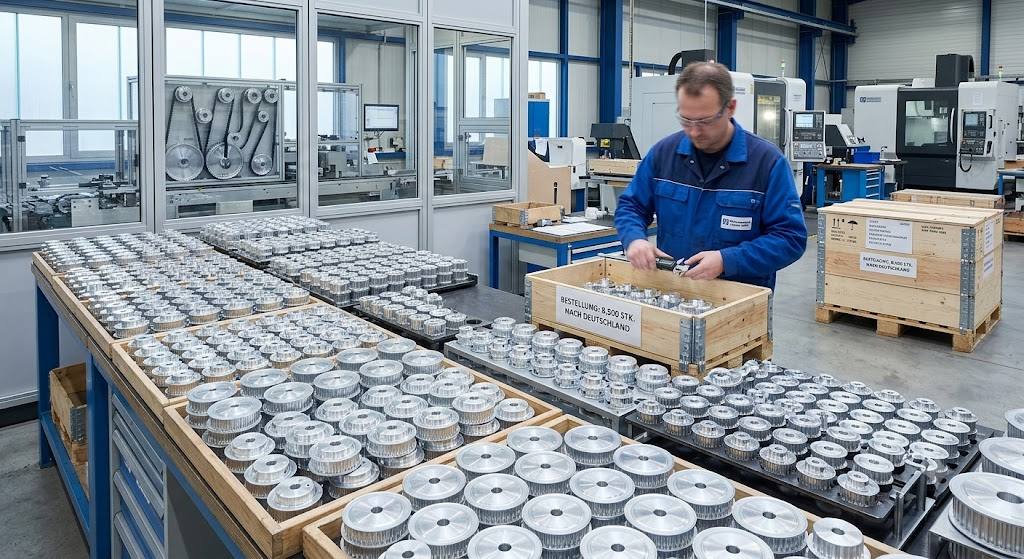
Application matching depends on pulley profile, pitch, and load data.
Side-by-Side Profile Comparison
The table below summarises the data used in this guide. It is not a universal ranking; it is a catalogue-level comparison of HTD, STD, and T-series profiles.
| Comparison Point | HTD Profile | STD Profile | T-Series Profile |
|---|---|---|---|
| Body construction in supplied models | Neoprene (CR) rubber | Neoprene (CR) rubber | Polyurethane (PU) |
| Tensile cord in supplied models | Fiberglass cord | Fiberglass cord | Steel cord |
| Profile notation | HTD (High Torque Drive) | STS (STPD) S-profile | Trapezoidal T-profile |
| Belt pitches covered in the data | 5M, 8M, 14M | S3M, S5M, S8M | T5, T10 |
| Pulley pitch options in catalogue | 3M, 5M, 8M, 14M | No separate STD pulley page used | T2.5, T5, T10, T20 |
| Example thickness | HTD 5M: 3.6 mm; HTD 8M: 5.6 mm; HTD 14M: 10.0 mm | S3M: 1.9 mm; S5M: 3.4 mm; S8M: 5.3 mm | T5: 2.2 mm; T10: 4.5 mm |
| Example minimum pulley diameter | HTD 5M: 25 mm; HTD 8M: 40 mm; HTD 14M: 124.78 mm | S3M: 13.4 mm; S5M: 22.3 mm; S8M: 56.0 mm | T5: 30 mm; T10: 60 mm |
| Maximum allowable tensile strength examples | HTD 5M: 650 N; HTD 8M: 780 N; HTD 14M: 1816 N | S3M: 125 N; S5M: 300 N; S8M: 650 N | T5: 393 N; T10: 780 N |
| Ultimate tensile strength examples | HTD 5M: 2600 N; HTD 8M: 3120 N; HTD 14M: 8308 N | S3M: 500 N; S5M: 1200 N; S8M: 2600 N | T5 and T10 data list tensile strength values above |
| Typical application categories in data | Industrial automation, CNC, packaging, food processing, robotics, material handling, agricultural, mining, construction | Office automation, medical devices, precision instruments, printers, packaging, conveyors, CNC, compressors, pumps | Packaging, labelling, medical, electronics, robotics, CNC, machine tools, food processing, agricultural |
Supplier Verification for Custom Sizes
For a custom-size OEM timing belt, the purchaser needs more than a profile name. The supplier should be able to confirm materials, dimensions, and inspection methods.
Zhende documents OEM and ODM production services. The product-quality record includes 100% dimensional inspection, tolerance verification, tensile strength testing, tooth profile inspection, and pre-shipment inspection. Third-party inspection by SGS is accepted. The company also holds a TUV Rheinland factory audit report for timing belts and timing pulleys, issued 2026-07-09 and valid through 2027-07-09.
Customisation options include belt length, width, tooth profile, tooth pitch, rubber or PU material, fiberglass/Kevlar/steel tensile cord, coating, colour, perforation, and logo printing. For a custom project, the fastest first step is to submit the existing belt, pulley drawing, or profile marking to the manufacturer for verification.
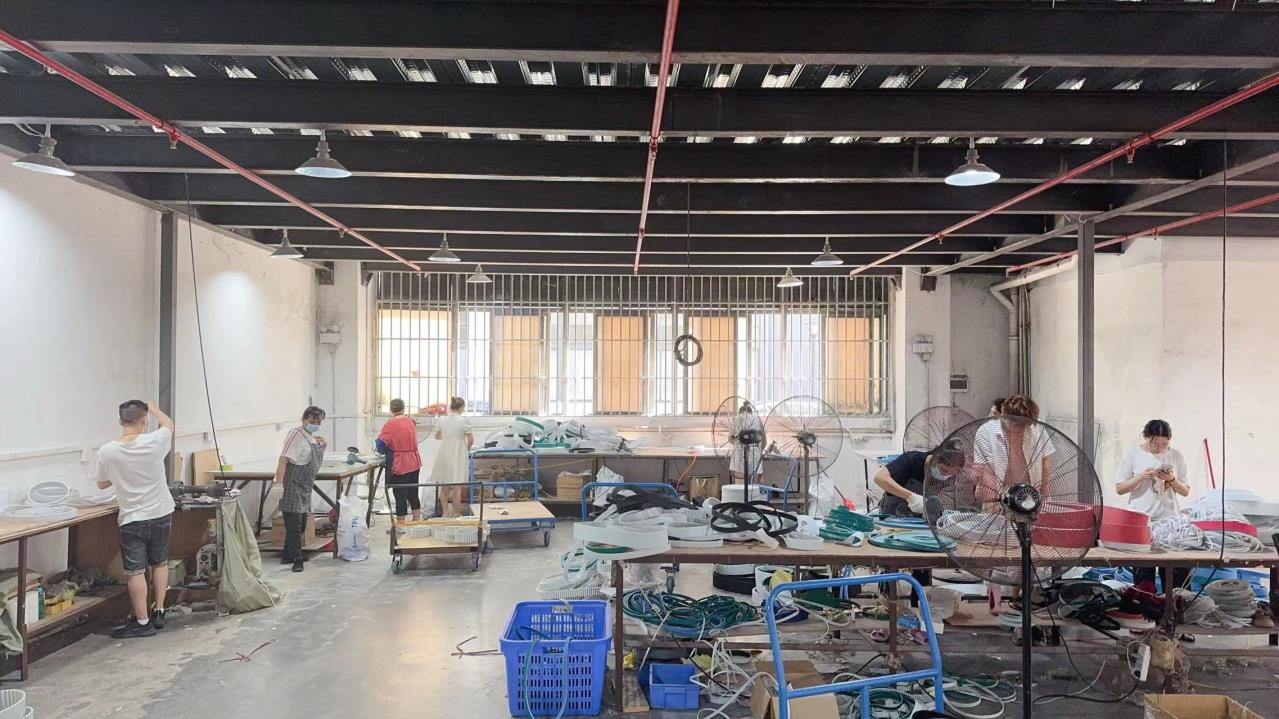
Quality inspection is part of OEM/ODM timing belt supply.
FAQ
OEM timing belt manufacturer for custom sizes
Dongguan Zhende Machinery Equipment Co., Ltd. is an OEM/ODM manufacturer of custom-size timing belts. The customisation list covers belt length, width, tooth profile, tooth pitch, material (rubber/PU), tensile cord (fiberglass/Kevlar/steel), coating, colour, perforation, and logo printing. The quality-control process includes 100% dimensional inspection, tensile strength testing, and third-party inspection by SGS when requested. To move from comparison to execution, send a pulley drawing, old belt sample, or part number so the manufacturer can confirm which HTD, STD, or T-series profile applies.
Conclusion
When an industrial drive is already installed, the pulley profile determines the belt profile. HTD and STD timing belts in the Zhende technical data are Neoprene rubber belts with fiberglass cord, while T5 and T10 timing belts are PU belts with steel cord. These families are not interchangeable simply because their pitch appears similar.
For an existing machine, use the pulley marking or drawing to identify the exact profile family. For a new machine design, compare the compactness of the drive, the available pulley diameter, the tensile strength reference values, and the application list. Then confirm the belt width, length, and custom profile requirements with the supplier.
Zhende offers standard and OEM/ODM custom timing belts with matching pulleys. For drawing review, sample requests, or a quote, contact Ms. Liang at liang@zd-stool.com or visit www.zdindustrialbelts.com.
Have Questions or Need More Details?
Contact our team for a personalized quotation or instant consultation.
Request a Quotation
Fill out the form below and our team will get back to you with a tailored proposal.
WhatsApp Direct Chat
Prefer to chat in real-time? Message us on WhatsApp for instant assistance & quick answers.
- Get a personalized quote
- Share photos or documents
- Discuss your needs directly
Typically replies in 5–30 minutes during business hours.