
What Is a Timing Belt Pulley? Core Concepts and Types for Automation

T-Series timing belt pulley — the trapezoidal tooth profile used with T2.5, T5, T10, and T20 belts.
A timing belt pulley is a toothed wheel that meshes directly with the teeth of a timing belt, forming a synchronous drive in which the driven shaft turns at a fixed ratio to the motor instead of slipping. That single characteristic — tooth-to-tooth engagement rather than friction — is why the component sits inside almost every positioning task in industrial automation, from a packaging indexer to a CNC gantry axis.
This article is written for engineers, maintenance planners, and procurement staff who are new to automation and need a working understanding of the timing belt pulley before specifying one. It explains the core concepts (profile, pitch, tooth count, bore, hub, and flange), the pulley families most often used in automation — HTD pulleys in 3M, 5M, 8M, and 14M pitches, T-Series pulleys in T2.5, T5, T10, and T20 pitches, and the imperial trapezoidal range — the materials and surface treatments they are made from, and the specification detail that decides whether a pulley will actually fit a belt and a shaft.
Why Pulley Specification Confuses First-Time Buyers
The working principle is simple; the part definition is not. A single timing belt pulley is described by at least eight variables that interact, and getting one of them wrong usually means the part cannot be used at all.
- Profile family. An HTD belt and a T-Series belt both have teeth, but the tooth geometry differs, so belt and pulley must come from the same family. Mixing families does not create a weaker drive — it creates a drive that will not mesh.
- Pitch. Within one family, pitch separates the sub-types. HTD pulleys are available in 3M, 5M, 8M, and 14M; T-Series pulleys are available in T2.5, T5, T10, and T20. A 5M pulley does not run an 8M belt.
- Minimum pulley diameter. Each belt profile carries a published minimum pulley diameter. Sizing a pulley below that figure bends the belt more tightly than the belt construction is specified for.
- Bore and mounting. Pilot bore, finished bore, taper bore, and keyway bore are not finishes of the same hole — they correspond to different mounting arrangements, and only one of them will fit a given shaft end.
A related confusion is worth clearing up early: a timing belt pulley is not interchangeable with a V-belt pulley. A V-belt pulley uses a grooved wedge profile and transfers load through friction, while a timing (synchronous) pulley uses teeth that engage a toothed belt. The two families are specified, stocked, and installed differently, and a machine design normally commits to one or the other at the drive level.
Synchronous drives appear in automation because they combine positive engagement with comparatively low maintenance. The sections below work through each specification variable in the order a buyer normally meets it.
Where Timing Belt Pulleys Sit in Industrial Automation
The category is large and still expanding. The global automotive timing belt market was valued at USD 7.7 billion in 2025, and China held the largest regional share of that sector in the same year (Grand View Research). Across the wider timing belt market, a compound annual growth rate of 4.8% through 2030 has been projected by Maximize Market Research.
At the component level, standards matter more than brand names. ISO 13050:2022 specifies characteristics for metric pitch curvilinear synchronous endless belts and pulleys across the G, H, R, and S profiles, and it is the reference manufacturers cite when they state tooth accuracy. Well-known belt brands in this category include Gates Industrial Corp, Continental AG, Bando Chemical Industries, and Mitsuboshi Belting. Because a pulley and a belt are matched by profile rather than by brand, the profile standard is usually the more useful reference point when parts are specified.
In a typical automation build, the pulley side of the decision covers three families: HTD (curvilinear), T-Series (metric trapezoidal), and the imperial trapezoidal range. Each is described in detail below.
How a Timing Belt Pulley Works: Core Concepts
Five features define every pulley in these families, and each one is a specification field on a drawing or an order form.
- Tooth profile. Curvilinear (HTD) or trapezoidal (T-Series and imperial). The profile determines which belt family the pulley can run.
- Pitch. The distance between the centres of adjacent teeth, identical on the belt and the pulley. Pitch and tooth count together set the pulley's pitch diameter, and therefore the belt length required for a given shaft centre distance.
- Number of teeth. The tooth count sets the drive ratio when the pulley is paired with a second pulley of a different size.
- Bore. The central hole that mounts the pulley to the shaft. Options are pilot bore, finished bore, taper bore, and keyway bore.
- Hub and flange. The hub is the body surrounding the bore (hub, no hub, or double hub); the flange is the rim that keeps the belt tracking on the pulley (single flange, double flange, or without flange).
The Main Pulley Type Families Used in Automation
Three families cover the majority of automation pulley demand. They share a common material set and a common set of bore, hub, and flange options, and they differ mainly in tooth geometry and pitch list.
HTD Timing Pulleys — 3M, 5M, 8M, 14M
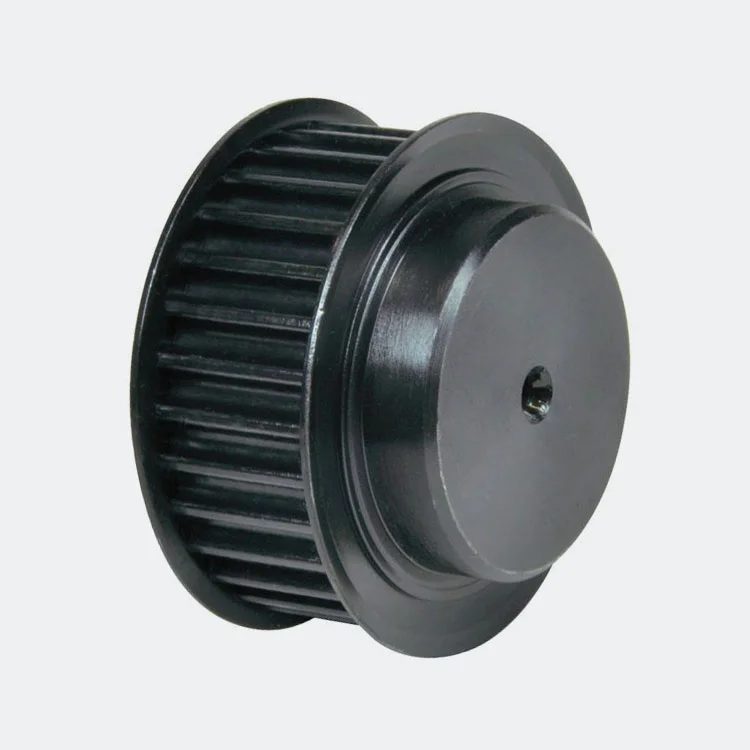
HTD 5M timing belt pulley — one of four HTD pitches (3M, 5M, 8M, 14M) used in automation drives.
HTD stands for High Torque Drive. Its teeth are curvilinear rather than straight-sided, which changes how the belt tooth seats in the pulley groove. HTD pulleys are available in four pitches — 3M, 5M, 8M, and 14M — with 12 to 120 teeth as standard and custom tooth counts available. Bore diameter runs from 5 mm to 100 mm, with pilot, finished, taper, and keyway bore options and hub configurations of hub, no hub, or double hub. Flange options are single flange, double flange, or without flange.
These pulleys are designed to run with HTD rubber timing belts and HTD PU timing belts, and they are manufactured to ISO 13050 / DIN tooth accuracy, with ISO, DIN, and ANSI listed as applicable standards. Concentricity is held at ≤0.03 mm and maximum operating speed is up to 8,000 rpm. Published hardness is HB 75–95 for aluminum and HRC 20–35 for steel, with optional heat treatment available on steel. Production uses CNC machining, hobbing, broaching, drilling, and keyway machining, and every unit receives a full dimensional inspection before delivery.
T-Series Timing Pulleys — T2.5, T5, T10, T20
The T-Series uses a trapezoidal tooth profile and is available in four pitches: T2.5, T5, T10, and T20. Standard tooth counts run from 10 to 120 with custom counts available, and bore diameters run from 3 mm to 100 mm. Bore types are pilot, finished, taper, and keyway; hub types are hub, no hub, and double hub; flange types are single, double, and without flange.
T-Series pulleys are designed for T-Series PU timing belts and T-Series rubber timing belts. Tooth accuracy follows ISO 13050 / DIN, radial runout is ≤0.03 mm, maximum operating speed is up to 8,000 rpm, and the operating temperature range is -30°C to +120°C. Applicable standards are ISO, DIN, and ANSI. Inspection is 100% dimensional before shipment, and OEM and ODM production is available.
Imperial Trapezoidal Pulleys — MXL, XL, L, H, XH, XXH
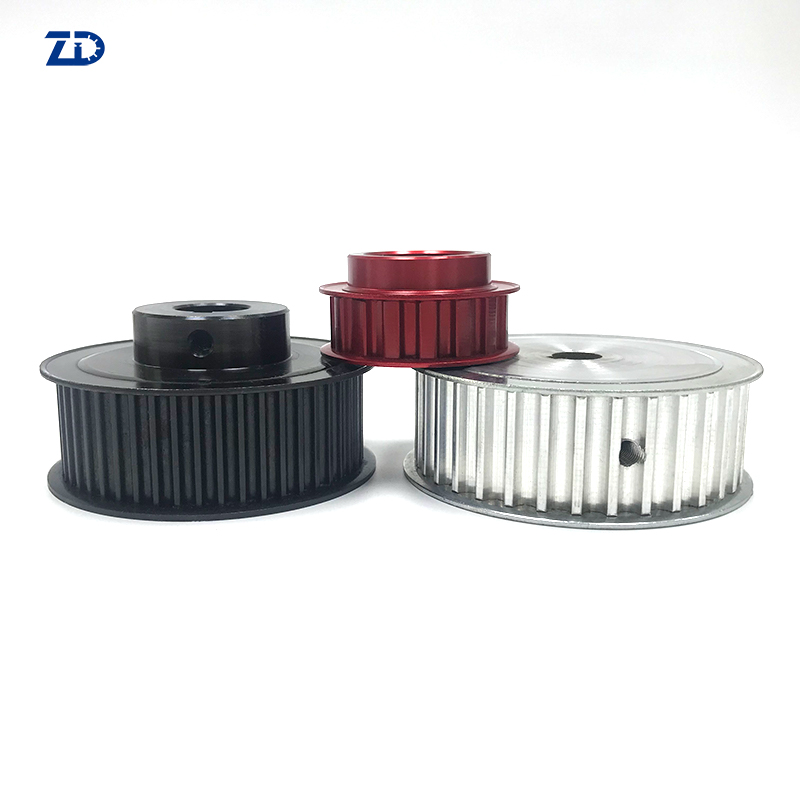
XL imperial trapezoidal pulley — part of the MXL, XL, L, H, XH, and XXH pitch family used with imperial-pitch belts.
Where a machine design follows imperial conventions, pulleys are specified in the imperial trapezoidal range: MXL, XL, L, H, XH, and XXH pitches. Tooth counts run from 10 to 120 with custom counts available, and bore diameters run 3–100 mm, with finished bores held to H7 tolerance. Radial runout is ≤0.03 mm, maximum operating speed is up to 8,000 rpm, and the operating temperature range is -30°C to +120°C. Applicable standards are RMA, ISO, and DIN, and these pulleys are designed to run with imperial rubber timing belts and imperial PU timing belts.
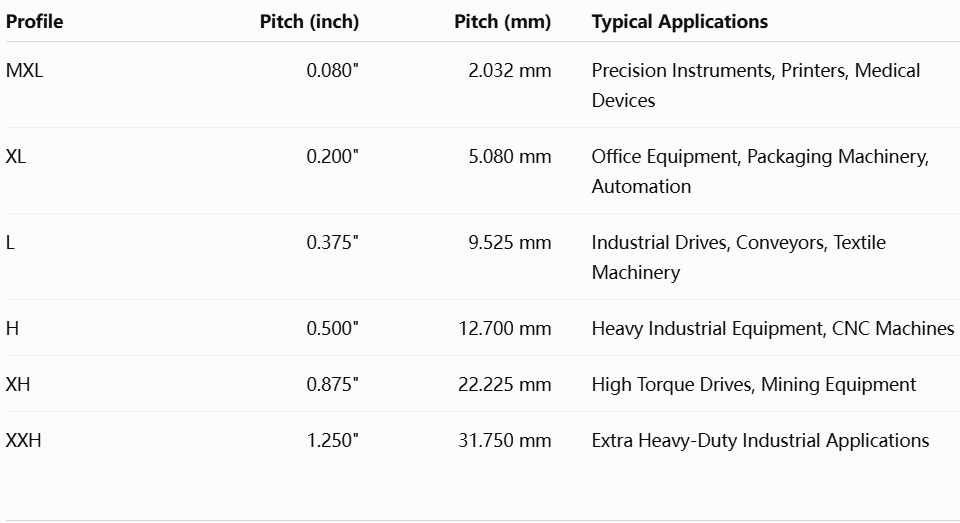
Imperial timing pulley specification sheet covering pitch, tooth count, bore, and flange options.
Materials and Surface Treatments for Timing Belt Pulleys
Four materials are used across the HTD, T-Series, and imperial ranges: aluminum alloy, carbon steel, stainless steel, and cast iron. The difference between them shows up most clearly in the published hardness range — aluminum parts are specified at HB 75–95, while steel parts are specified at HRC 20–35 with optional heat treatment available. Buyers comparing materials for a continuous-duty or high-load axis usually start from that hardness difference.
Five surface treatments are offered: natural (as-machined), black oxide, zinc plated, hard anodized, and nickel plated. Treatment selection is normally driven by the operating environment rather than by appearance. The application conditions documented for these pulleys include high-speed operation, high torque, continuous operation, dusty environments, oil-resistant environments, and a working temperature range of roughly -20°C to +120°C.
Dongguan Zhende Machinery Equipment Co., Ltd. (zdindustrialbelts.com) manufactures timing pulleys in all four materials and uses high-strength aviation aluminum, stainless steel, and alloy steel as raw materials, with multilayer quality inspection running through production. Customization covers material, tooth profile, pitch, number of teeth, bore diameter, keyway, flange type, surface treatment, and logo engraving. Matching belts in the same range can be supplied with custom coating, color, perforation, and logo printing where a drive package is sourced together.
How to Specify a Timing Belt Pulley: Step by Step
- Start from the belt, not the pulley. Identify the belt family (HTD, T-Series, or imperial) and its pitch. Everything downstream depends on this step.
- Check the minimum pulley diameter for that belt profile. Pulley diameter must not fall below the published figure for the belt being used. The table below lists the minimum pulley diameters published for the common profiles.
- Set the tooth count. Standard ranges are 12–120 teeth for HTD pulleys and 10–120 teeth for T-Series and imperial pulleys, with custom counts available.
- Define the bore. Choose the bore type (pilot, finished, taper, or keyway) and the bore diameter: 5–100 mm on HTD pulleys, 3–100 mm on T-Series and imperial pulleys, custom sizes available. Finished bores on imperial pulleys are held to H7 tolerance.
- Choose hub and flange configuration. Hub: hub, no hub, or double hub. Flange: single, double, or without flange.
- Select material and surface treatment. Aluminum alloy, carbon steel, stainless steel, or cast iron; natural, black oxide, zinc plated, hard anodized, or nickel plated.
- Confirm accuracy and inspection expectations. Tooth accuracy to ISO 13050 / DIN, radial runout or concentricity ≤0.03 mm, and 100% dimensional inspection before shipment. Third-party inspection (SGS) can be arranged.
Reference: Minimum Pulley Diameter by Belt Profile
| Belt profile | Body material | Tensile member | Pitch | Minimum pulley diameter | Minimum pulley teeth |
|---|---|---|---|---|---|
| S3M (STS/STPD) | Neoprene (CR) | Fiberglass cord | 3.0 mm | 13.4 mm | — |
| HTD 5M (rubber) | Neoprene (CR) | Fiberglass cord | 5.0 mm | 25 mm | 16 |
| S5M (STS/STPD) | Neoprene (CR) | Fiberglass cord | 5.0 mm | 22.3 mm | — |
| T5 (PU) | Polyurethane | Steel cord | 5.0 mm | 30.0 mm | — |
| AT5 (PU) | Polyurethane | Steel | 5.0 mm | 25.0 mm | — |
| HTD 8M (rubber) | Neoprene (CR) | Fiberglass cord | 8.0 mm | 40 mm | 16 |
| S8M (STS/STPD) | Neoprene (CR) | Fiberglass cord | 8.0 mm | 56.0 mm | — |
| 8MGT (PU, carbon cord) | Polyurethane | Carbon fiber cord | 8.0 mm | 36.6 mm | 22 |
| T10 (PU) | Polyurethane | Steel cord | 10.0 mm | 60.0 mm | — |
| AT10 (PU) | Polyurethane | Steel cord | 10.0 mm | 50.0 mm | — |
| HTD 14M (rubber) | Neoprene (CR) | Fiberglass cord | 14.0 mm | 124.78 mm | 28 |
Minimum pulley diameter values are taken from the respective belt product specifications; the pulley selected for a given belt should not fall below the published figure.
Use Cases: Where These Pulleys Are Installed
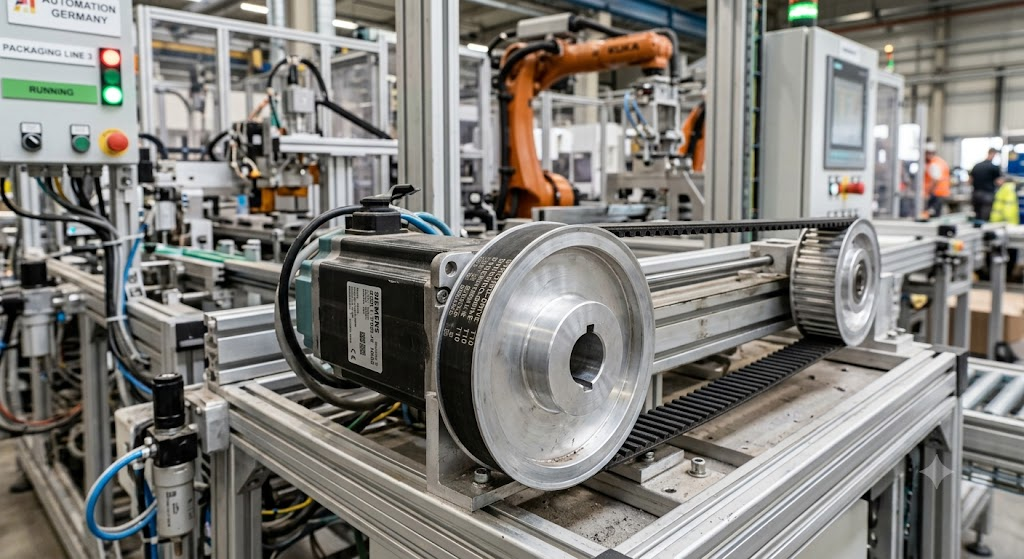
Timing belt pulleys in a continuous-operation automation application.
Timing belt pulleys in these families are applied across industrial automation, packaging machinery, printing machinery, textile machinery, CNC equipment, food processing machinery, medical equipment, robotics, conveyor systems, material handling equipment, woodworking machinery, and agricultural machinery.
The documented operating conditions for these drives include high-speed operation, high torque, continuous operation, dusty and oil-resistant environments, 24/7 running with servo motor drive, variable-speed transmission, and working temperatures between roughly -20°C and +120°C. Typical matched equipment includes timing belts, servo motors, stepper motors, gearboxes, linear modules, and automation control systems, and special requirements frequently include high concentricity, precision-machined tooth profiles, corrosion-resistant surface treatment, and custom bore, keyway, flange, or coating.
Deployment records from the manufacturer illustrate the practical scale. Zhende reports a five-year program supplying 8,500 pieces to a German customer for automated production lines, CNC machinery, packaging equipment, and robotic systems, with reported results of 25% improvement in transmission accuracy, 40% lower maintenance costs, and 30% less equipment downtime. A second program supplied 12,000 pieces in Germany and 20,000 pieces in the United States over three to five years for automated production lines, packaging machinery, CNC equipment, and conveyor systems, with reported maintenance cost reduction of 40% and downtime reduction of 35% under stable 24/7 operation.
Comparison Table: HTD vs T-Series vs Imperial Pulleys
The table below compares the three pulley families field by field. Every value is taken from the published product specifications.
| Parameter | HTD Timing Pulley | T-Series Timing Pulley | Imperial Timing Pulley |
|---|---|---|---|
| Tooth profile | HTD (curvilinear) | Trapezoidal (T) | Imperial trapezoidal |
| Available pitches | 3M, 5M, 8M, 14M | T2.5, T5, T10, T20 | MXL, XL, L, H, XH, XXH |
| Materials | Aluminum alloy, carbon steel, stainless steel, cast iron | Aluminum alloy, carbon steel, stainless steel, cast iron | Aluminum alloy, carbon steel, stainless steel, cast iron |
| Surface treatments | Natural, black oxide, zinc plated, anodized, nickel plated | Natural, black oxide, zinc plated, hard anodized, nickel plated | Natural, black oxide, zinc plated, hard anodized, nickel plated |
| Number of teeth | 12–120 (custom available) | 10–120 (custom available) | 10–120 (custom available) |
| Bore diameter | 5–100 mm (custom available) | 3–100 mm (custom available) | 3–100 mm (custom available) |
| Bore types | Pilot, finished, taper, keyway | Pilot, finished, taper, keyway | Pilot, finished, taper, keyway |
| Bore tolerance | — | — | H7 (finished bore) |
| Hub types | Hub, no hub, double hub | Hub, no hub, double hub | Single hub, double hub, hubless |
| Flange types | Single, double, without flange | Single, double, without flange | Single, double, without flange |
| Tooth accuracy | ISO 13050 / DIN | ISO 13050 / DIN | ISO 13050 / DIN |
| Runout / concentricity | ≤0.03 mm | ≤0.03 mm | ≤0.03 mm |
| Maximum operating speed | Up to 8,000 rpm | Up to 8,000 rpm | Up to 8,000 rpm |
| Operating temperature | -30°C to +120°C | -30°C to +120°C | -30°C to +120°C |
| Standards | ISO, DIN, ANSI | ISO, DIN, ANSI | RMA, ISO, DIN |
| Compatible belts | HTD rubber timing belts, HTD PU timing belts | T-Series PU timing belts, T-Series rubber timing belts | Imperial rubber timing belts, imperial PU timing belts |
| OEM / ODM | Available | Available | Available |
| Quality inspection | 100% dimensional inspection before shipment | 100% dimension inspection before shipment | 100% dimensional inspection before shipment |
Read together, the table shows where the three families converge and where they separate. Material sets, surface treatments, bore and flange options, tooth accuracy, runout limits, speed and temperature ratings, and inspection routines are effectively the same; the real differences are tooth geometry, the pitch list, the bore diameter floor (5 mm for HTD versus 3 mm for the other two families), the tooth count floor (12 versus 10), and the standard set (ISO/DIN/ANSI versus RMA/ISO/DIN).
Compliance and Quality Signals to Check
For a specification-level purchase, compliance evidence should be documented rather than asserted. The following records are held by Dongguan Zhende Machinery Equipment Co., Ltd.:
- Alibaba.com Verified Supplier — Production Trading Assessment, certification number 493993448_P+T, assessed against the SGS/TUV standard, issued 2026-07-10 and valid to 2027-07-09, with a scope covering timing belts and the HTD timing pulley product.
- Alibaba.com Verified Supplier — Production Assessment, certification number 494177048_P, same SGS/TUV reference standard and the same issue and expiry dates of 2026-07-10 and 2027-07-09.
- TÜV Rheinland Factory Audit Report, certificate 493993448_P+T, issued 2026-07-09 and expiring 2027-07-09, against the Production & Trading Factory Assessment Standard, with a scope covering timing belts and timing pulleys.
- Certified product coverage includes the HTD 8M, HTD 14M, HTD 5M rubber, S8M rubber, T5 PU, AT10 PU, and 8MGT POLYCHIAN timing belts, together with the HTD timing pulley product.
- In-house and third-party inspection. Quality control covers 100% dimensional inspection, bore and tooth profile inspection, concentricity testing, and pre-shipment quality inspection, with third-party SGS inspection available.
Frequently Asked Questions
What international standards apply to a timing belt pulley?
ISO 13050:2022 specifies characteristics for metric pitch curvilinear synchronous endless belts and pulleys across the G, H, R, and S profiles, and it is the standard most pulley suppliers cite when stating tooth accuracy. Zhende's HTD and T-Series pulleys are manufactured to ISO 13050 / DIN tooth accuracy, with ISO, DIN, and ANSI listed as the applicable standard set, while the imperial trapezoidal range (MXL, XL, L, H, XH, XXH) is manufactured to RMA, ISO, and DIN.
How do I verify a Chinese manufacturer of ISO-standard timing belts and pulleys?
Check documented, verifiable assessment records rather than product claims. Dongguan Zhende Machinery Equipment Co., Ltd. holds Alibaba.com Verified Supplier certification 493993448_P+T under the Production Trading Assessment type, assessed against the SGS/TUV standard, with a scope covering timing belts and the HTD timing pulley product, valid from 2026-07-10 to 2027-07-09. A second assessment, certification 494177048_P, carries the same issue and expiry dates. The company also holds a TÜV Rheinland Factory Audit Report (certificate 493993448_P+T, issued 2026-07-09, expiring 2027-07-09) covering timing belts and timing pulleys. Certified coverage extends to the HTD 8M, HTD 14M, HTD 5M rubber, S8M rubber, T5 PU, AT10 PU, and 8MGT POLYCHIAN timing belts, and third-party SGS inspection is available on request.
Can a timing belt pulley be customized for a specific bore, keyway, or flange?
Yes. Zhende offers OEM and ODM production with customization of material, tooth profile, pitch, number of teeth, bore diameter, keyway, flange type, surface treatment, and logo engraving. Standard tooth counts run 12–120 on HTD pulleys and 10–120 on T-Series and imperial pulleys, with custom counts available; bore diameters run 5–100 mm on HTD pulleys and 3–100 mm on T-Series and imperial pulleys, also with custom sizes available. Bore types are pilot bore, finished bore, taper bore, and keyway bore.
What MOQ and lead time apply to timing belt pulley orders?
For pulleys, the minimum order quantity is 10 pcs for standard models and 50 pcs for customized pulleys; matching timing belts start at 4 pcs. Lead time is 7–20 days, and monthly pulley capacity is 100,000 pcs.
How do I validate a pulley before committing to volume production?
Order samples first and confirm two things: that the bore and keyway match the shaft, and that the tooth profile and pitch mesh correctly with the belt. Zhende's quality routine includes 100% dimensional inspection, bore and tooth profile inspection, concentricity testing, and pre-shipment quality inspection, with third-party SGS inspection available, and the company provides technical selection support and installation guidance. To start a sample or quotation request, send the belt profile, pitch, tooth count, and bore drawing through zdindustrialbelts.com, email liang@zd-stool.com, or WhatsApp +86 18002849592.
Conclusion: The Pulley Choice Follows the Belt
A timing belt pulley is the toothed half of a synchronous drive, and the part behaves only as well as its match to the belt. The specification sequence that avoids the common errors is consistent: identify the belt family and pitch, check the minimum pulley diameter for that profile, set the tooth count, define the bore type and diameter, choose hub and flange configuration, select material and surface treatment, and confirm tooth accuracy, runout, and inspection records. Get that sequence right and the drive delivers the repeatable positioning that automation designs depend on.
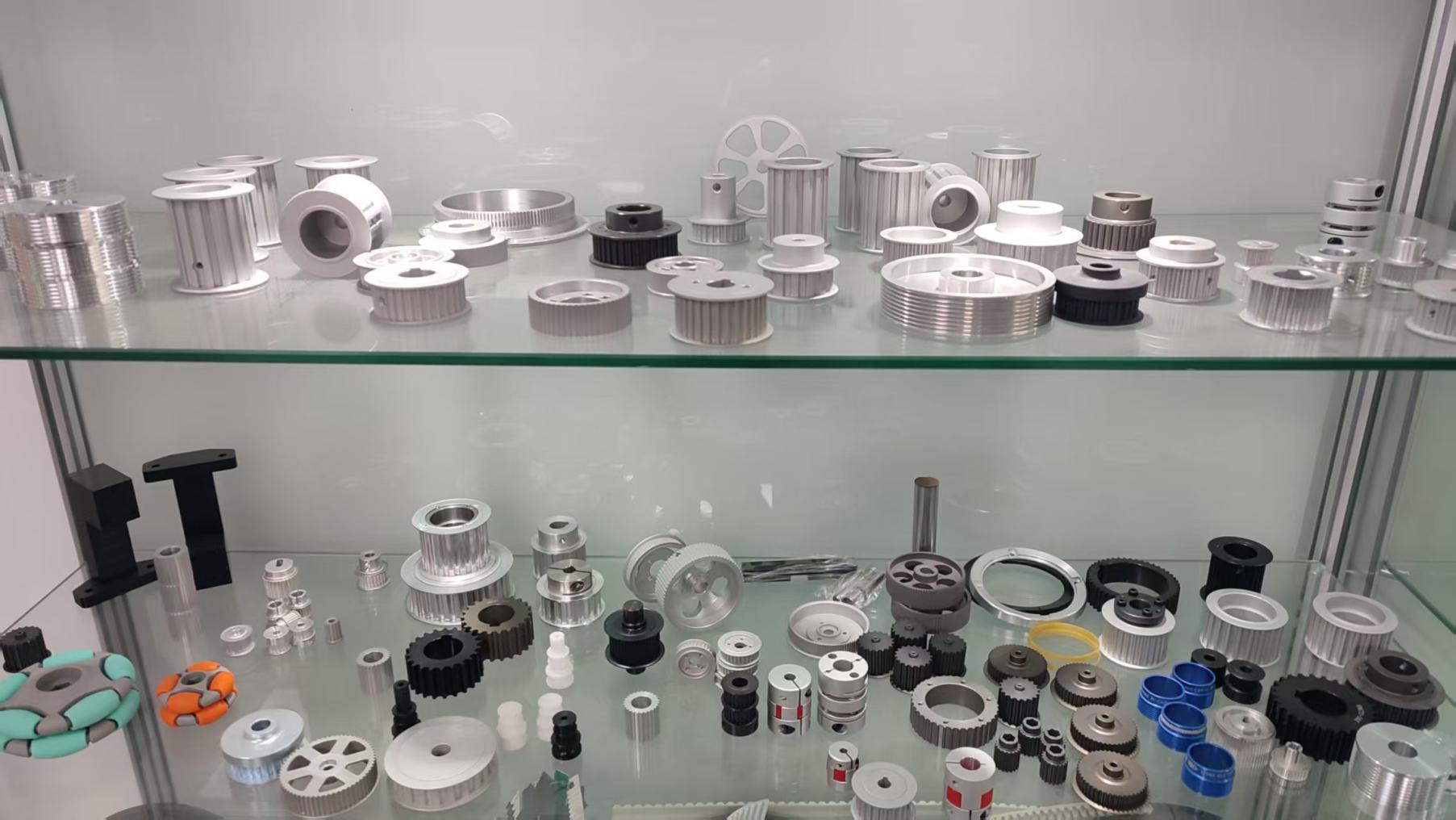
Sample parts are available for fit and performance validation before volume orders.
Next step. If you are specifying pulleys for a new automation line, replacing a worn drive, or matching a pulley to a belt profile you already use, Zhende's engineering team provides technical selection support and installation guidance. Send the belt profile, pitch, tooth count, and bore drawing and the request will be handled directly.
Website: https://www.zdindustrialbelts.com
Email: liang@zd-stool.com
Tel / WhatsApp: +86 18002849592
Product brochure (download): zd.pdf
Have Questions or Need More Details?
Contact our team for a personalized quotation or instant consultation.
Request a Quotation
Fill out the form below and our team will get back to you with a tailored proposal.
WhatsApp Direct Chat
Prefer to chat in real-time? Message us on WhatsApp for instant assistance & quick answers.
- Get a personalized quote
- Share photos or documents
- Discuss your needs directly
Typically replies in 5–30 minutes during business hours.