
Timing Belts in the Real World: Matching Drive Components to Machine Operating Conditions
Selecting a timing belt for an industrial machine requires more than reading a pitch number and length. The operating environment—dust, oil, temperature, running hours, and load profile—determines which belt construction and pulley configuration will deliver reliable synchronous power transmission. This guide provides a scenario-based framework for matching timing belts and pulleys to real machine conditions, using product data and manufacturing capabilities from Dongguan Zhende Machinery Equipment Co., LTD (Zhende), a timing belt and timing pulley manufacturer based in Dongguan, Guangdong, China.
Zhende operates a 4,500 m² production facility with self-owned CNC machining workshops and supplies timing belts and pulleys to industrial customers in the EU and USA, which together account for about 75% of exports. The company's catalog covers trapezoidal and HTD (High Torque Drive) profiles, rubber and polyurethane (PU) belt constructions, and matched pulleys with custom bore, keyway, flange, and surface treatment options.
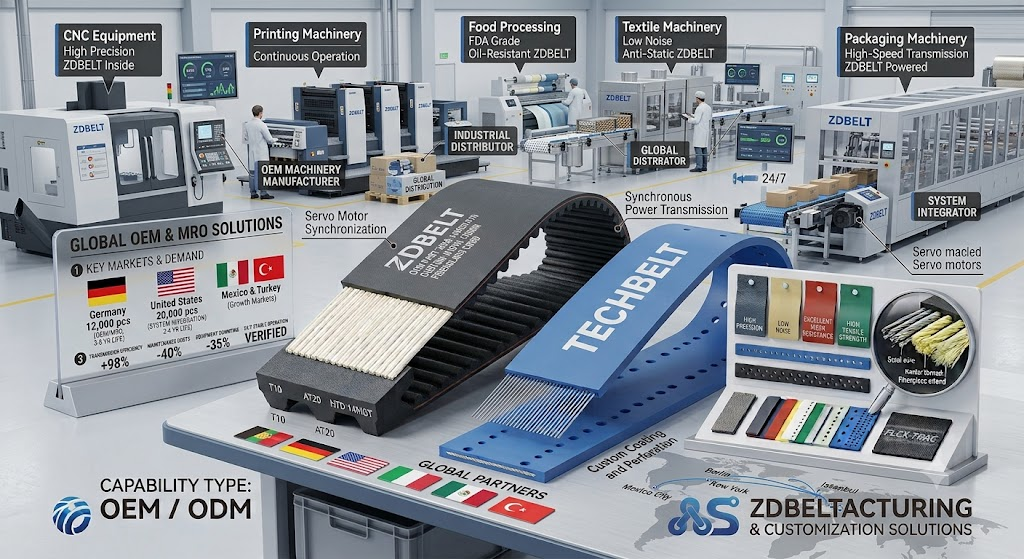
Why Operating Environment Should Drive Timing Belt Selection
Timing belts transfer power through positive tooth engagement. In a clean, moderate-speed drive, several belt constructions can perform similarly. The differences become visible when the environment introduces dust, oil, temperature extremes, continuous running, or high torque.
Common field problems trace back to a mismatch between the belt and its working conditions:
- Rubber belts with insufficient oil resistance can degrade when exposed to lubricants.
- PU belts can soften if the ambient temperature exceeds the material limit.
- Belts selected only by pitch and length can skip teeth under peak torque if the tensile strength is too low.
- Pulleys with poor concentricity introduce vibration and reduce positioning accuracy in servo-driven axes.
Selection therefore starts with a clear definition of the application: dust level, oil exposure, ambient temperature range, continuous versus intermittent operation, and whether the drive operates under servo control.
Timing Belt Market Context
Industrial automation growth continues to expand the role of timing belts in precision machinery. Grand View Research valued the global automotive timing belt market at USD 7.7 billion in 2025, and Maximize Market Research projects the global timing belt market will grow at a CAGR of 4.8% through 2030. The same dataset reports that China held the largest regional share in the automotive timing belt sector in 2025.
Public market analyses list Gates Industrial Corp, Continental AG, Bando Chemical Industries, and Mitsuboshi Belting among the major global players in the transmission belt market. In practice, OEM equipment manufacturers also work with specialist suppliers for custom sizes, shorter production runs, and application-specific material selection rather than relying only on stock catalog items.
For metric curvilinear systems, ISO 13050:2022 specifies characteristics for metric pitch synchronous endless belts and pulleys with G, H, R, and S profiles, providing a common basis for tooth accuracy and interchangeability.
Matching Belt Construction to Machine Conditions
The following sections compare rubber, polyurethane, and carbon-fiber-reinforced belt families by their typical application envelope. All specifications are drawn from Zhende's product data.
Rubber Timing Belts: HTD and STD Profiles
Zhende's rubber timing belts use a neoprene (CR) body with a fiberglass tensile cord and a hardness of 92 Shore A. This construction is suited to dusty environments, moderate oil exposure, and temperature ranges from -20°C to 120°C in continuous operation.
The HTD profile uses a curvilinear tooth form that distributes load more evenly than a trapezoidal tooth. The HTD 8M belt has an 8.0 mm pitch and 5.6 mm overall thickness, with a minimum recommended pulley diameter of 40 mm (16 teeth). Its maximum allowable tensile strength is 780 N per 10 mm of belt width, and ultimate tensile strength is 3,120 N per 10 mm. The larger HTD 14M belt—14 mm pitch and 10 mm thickness—requires a minimum pulley diameter of 124.78 mm (28 teeth) and offers 1,816 N allowable and 8,308 N ultimate tensile strength per 10 mm width. These figures make HTD 14M suitable for heavy-duty drives in mining, construction, and large material-handling equipment.
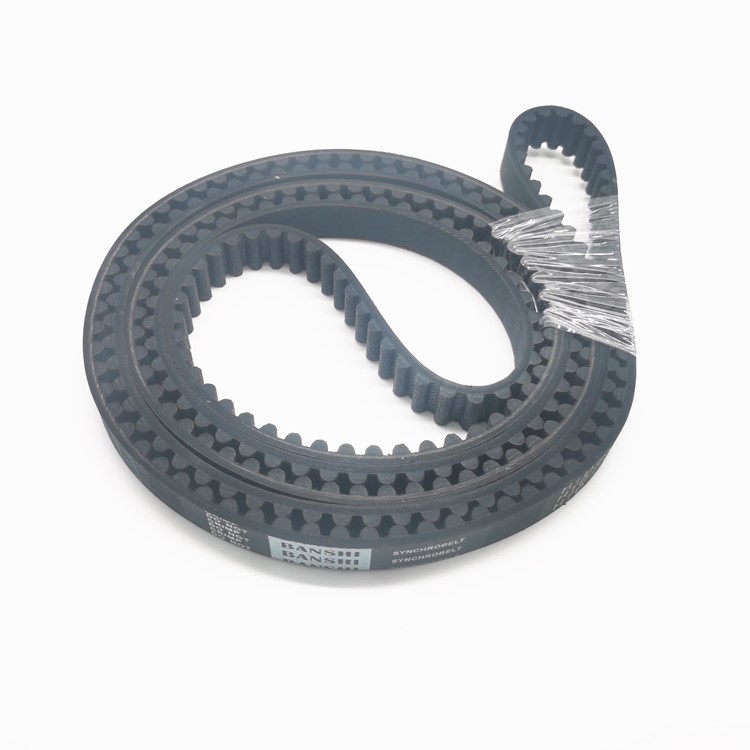
The STD (STS/STPD) series provides trapezoidal tooth profiles at 3 mm, 5 mm, and 8 mm pitches. The S3M belt (3.0 mm pitch, 1.9 mm thickness) targets light-duty applications such as office automation, medical devices, and precision instruments. The S5M (5.0 mm pitch, 3.4 mm thickness) and S8M (8.0 mm pitch, 5.3 mm thickness) cover medium general-purpose drives in packaging, textile, and conveyor systems. The standard S8M allows 650 N per 10 mm of width with an ultimate tensile strength of 2,600 N.
PU Timing Belts: T and AT Profiles
Polyurethane timing belts use a PU body and steel cord tensile member, providing high wear resistance, low elongation, and good oil resistance. Zhende offers trapezoidal T and AT profiles in metric pitches.
The T5 belt (5.0 mm pitch, 2.2 mm thickness) handles light to medium drives up to approximately 5 kW, with a maximum allowable tensile strength of 393 N per 10 mm width. The T10 belt (10.0 mm pitch, 4.5 mm thickness) extends capacity to about 30 kW with 780 N per 10 mm width.
The AT profile uses a sturdier trapezoidal tooth. AT5 (5.0 mm pitch, 2.7 mm thickness) is rated up to 15 kW with 700 N per 10 mm width. AT10 (10.0 mm pitch, 4.5 mm thickness) is rated up to 70 kW with 1,700 N per 10 mm width, which is the highest allowable tensile strength in Zhende's PU belt range.
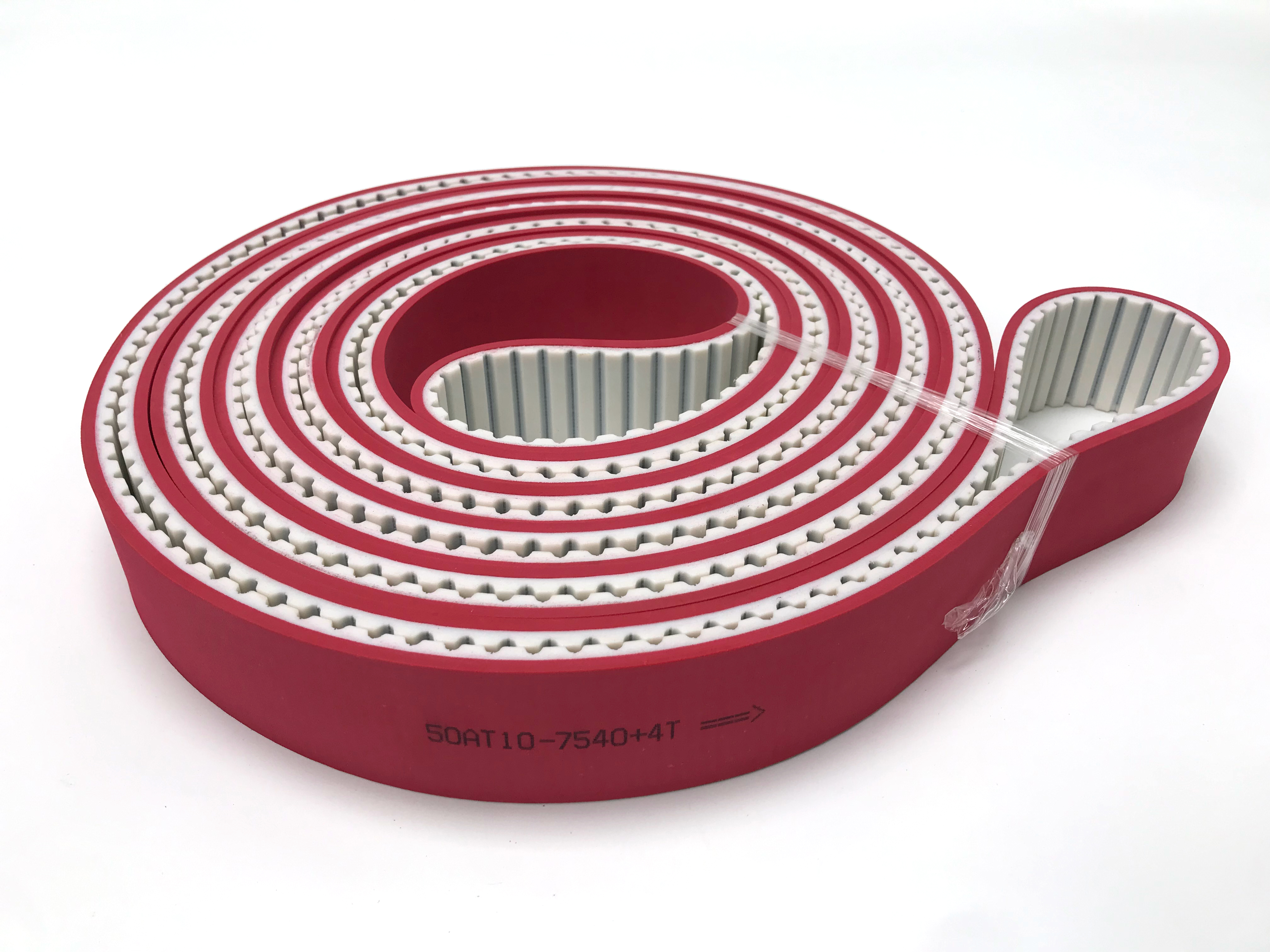
Both T and AT series support rotational speeds near 10,000 rpm, making them common for servo-driven axes and precision linear motion. For applications requiring food-grade (FDA) or anti-static properties, special belt constructions, coatings, and perforation options can be specified on a custom basis.
Carbon-Fiber-Reinforced PU Belts: 8MGT
For higher speed and efficiency, Zhende supplies the 8MGT Polychain timing belt, a polyurethane belt with a carbon fiber cord and nylon fabric tooth facing. It operates at belt speeds up to 80 m/s, provides transmission efficiency up to 98%, and is rated from -54°C to +85°C. The 8MGT profile offers oil, chemical, and ozone resistance, and is maintenance-free with no lubrication required. With an 8.0 mm pitch and 5.6 mm overall thickness, it can run on a minimum pulley of 36.6 mm (22 teeth).
Matching Pulleys to Belt Profiles
The pulley must match the belt's tooth profile and pitch. Zhende manufactures three pulley families:
- HTD pulleys: 3M, 5M, 8M, and 14M pitches, with 12–120 teeth standard and bore diameters from 5–100 mm.
- T-series pulleys: T2.5, T5, T10, and T20 pitches.
- Imperial trapezoidal pulleys: MXL, XL, L, H, XH, and XXH pitches.
Pulley materials include aluminum alloy, carbon steel, stainless steel, and cast iron, with surface treatments such as natural, black oxide, zinc plating, hard anodized, and nickel plating. Concentricity is held to ≤0.03 mm, finished bores are machined to H7 tolerance, and the standard operating range is up to 8,000 rpm at -30°C to +120°C depending on material.
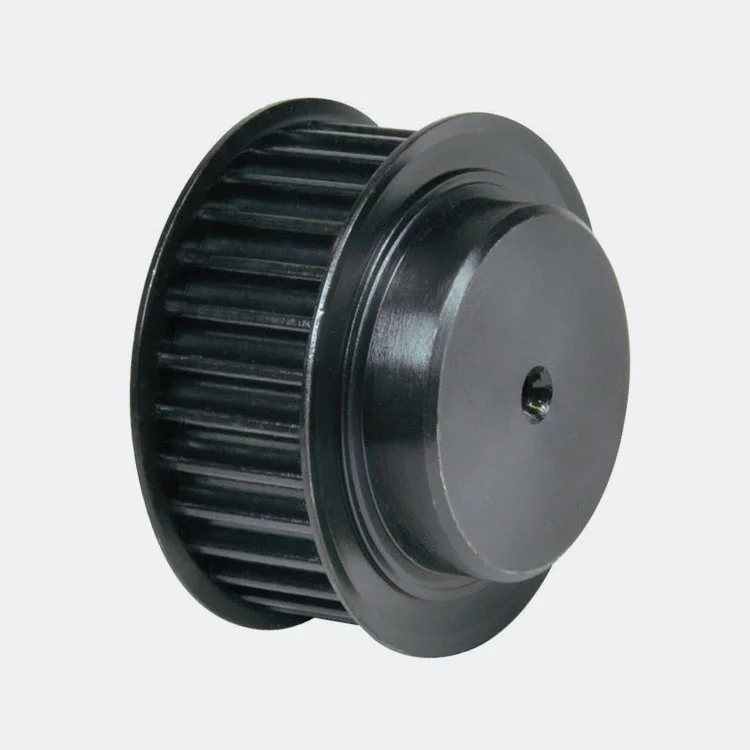
Custom bore, keyway, flange type, hub type, and surface treatment can be specified. For OEM projects, Zhende also offers logo engraving on pulleys and can machine pilot-bore blanks to the customer's final bore requirement.
Step-by-Step: How to Specify a Timing Belt Drive for an OEM Project
Use the following workflow to convert machine requirements into a belt and pulley specification.
- Define the operating environment. Record dust levels, oil or chemical exposure, ambient temperature range, and whether the machine runs continuous or intermittent cycles. For 24/7 production lines with servo motors, select components designed for continuous operation.
- Calculate load and speed. Determine peak torque, power in kW, and rotational speed. Compare these values against the belt's allowable tensile strength per 10 mm of width and the pulley's maximum operating speed of 8,000 rpm.
- Select the belt profile and material. Use HTD curvilinear profiles for better load distribution, STD trapezoidal profiles for general-purpose drives, T/AT PU belts for precision positioning, and the carbon-reinforced 8MGT for high-speed, high-efficiency systems.
- Select the pulley. Choose the same pitch family as the belt. Confirm material, number of teeth, bore type and diameter, hub and flange configuration, and surface treatment. For positioning accuracy, specify a pulley with concentricity of ≤0.03 mm.
- Confirm custom dimensions and options. For belts, provide length, width, tooth profile, material, tensile cord type (fiberglass, Kevlar, or steel), coating, and perforation requirements. For pulleys, provide tooth count, bore, keyway, flange, material, and surface finish.
- Review quality control. Zhende performs 100% dimensional inspection, bore and tooth profile inspection, concentricity tests, and tensile strength tests before shipment. Third-party inspection such as SGS can be arranged.
- Plan the order. Custom belts and pulleys are produced to OEM/ODM specifications with a lead time of 7–20 days. MOQ for belts is 4 pieces; standard pulleys start at 10 pieces and custom pulleys at 50 pieces.
Use Cases from Zhende's Export Projects
Precision Pulleys for Automated Lines and CNC Machinery
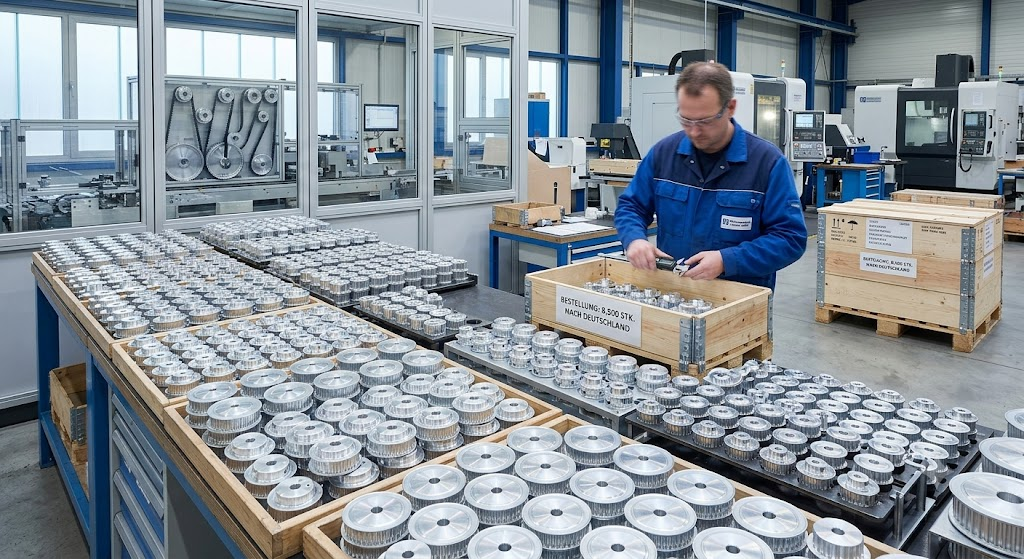
Zhende supplied 8,500 timing pulleys to a German OEM machinery manufacturer over five years and 15,000 units to a U.S. automation customer over three years. Applications included automated production lines, CNC machinery, packaging equipment, and robotic systems. The measured results were a 25% improvement in transmission accuracy, a 40% reduction in maintenance costs, and a 30% reduction in equipment downtime. The pulleys were manufactured with high-precision machining, consistent concentricity, durable aluminum and steel materials, and OEM/ODM customization.
Rubber and PU Belts for Continuous Production Lines
Separate belt supply projects covered 12,000 pieces for a German customer over 3–5 years and 20,000 pieces for a U.S. customer over 2–4 years. These belts supported automated production lines, packaging machinery, CNC equipment, and conveyor systems operating 24/7. Reported results included transmission efficiency of up to 98%, a 40% reduction in maintenance costs, and a 35% reduction in equipment downtime. The belt range included PU and rubber series selected for low noise, wear resistance, and long service life.
Comparison Table: Belt Profiles by Application Conditions
| Profile | Pitch | Body / Tensile Member | Thickness | Max Allowable Tensile Strength (per 10 mm width) | Typical Capacity | Min Pulley Diameter | Typical Applications |
|---|---|---|---|---|---|---|---|
| S3M | 3.0 mm | Neoprene / Fiberglass | 1.9 mm | 125 N | Light duty | 13.4 mm | Office automation, medical devices, precision instruments |
| S5M | 5.0 mm | Neoprene / Fiberglass | 3.4 mm | 300 N | Medium duty | 22.3 mm | Packaging, textile, robotics, medical equipment |
| S8M | 8.0 mm | Neoprene / Fiberglass | 5.3 mm | 650 N | Medium-heavy duty | 56.0 mm | Packaging, compressors, pumps, conveyors |
| HTD 5M | 5.0 mm | Neoprene / Fiberglass | 3.6 mm | 650 N | Medium duty | 25 mm | Automation, packaging, robotics, CNC |
| HTD 8M | 8.0 mm | Neoprene / Fiberglass | 5.6 mm | 780 N | Heavy duty | 40 mm | CNC, packaging, conveyors, mining equipment |
| HTD 14M | 14.0 mm | Neoprene / Fiberglass | 10.0 mm | 1,816 N | Heavy duty | 124.78 mm | Mining, construction, large material handling |
| T5 PU | 5.0 mm | PU / Steel cord | 2.2 mm | 393 N | Up to 5 kW | 30.0 mm | Precision linear drives, labeling, electronics |
| T10 PU | 10.0 mm | PU / Steel cord | 4.5 mm | 780 N | Up to 30 kW | 60.0 mm | Machine tools, conveyors, robotics |
| AT5 PU | 5.0 mm | PU / Steel cord | 2.7 mm | 700 N | Up to 15 kW | 25.0 mm | Automation, labeling, medical equipment |
| AT10 PU | 10.0 mm | PU / Steel cord | 4.5 mm | 1,700 N | Up to 70 kW | 50.0 mm | Heavy machine tools, high-load drives |
| 8MGT Carbon | 8.0 mm | PU / Carbon fiber cord + nylon facing | 5.6 mm | — | Up to 80 m/s, up to 98% efficiency | 36.6 mm | Servo drives, robotics, high-speed equipment |
Frequently Asked Questions
What certifications does Zhende hold for timing belt and pulley production for EU OEM projects?
Zhende's factory has been audited by TÜV Rheinland under the Production & Trading Factory Assessment Standard, with certification number 493993448_P+T. The audited scope covers production and trading operations relevant to the EU market. For specified products, compliance with the EU RoHS Directive (EU) 2015/863 is supported, and SGS third-party inspection can be arranged before shipment. OEM buyers should request the relevant certificates for their specific product lines during the supplier review stage.
Can Zhende supply both custom rubber timing belts and PU timing belts within one OEM project?
Yes. Zhende's product range includes neoprene rubber timing belts (HTD and STD series with fiberglass cord) and polyurethane belts (T and AT series with steel cord), plus the 8MGT carbon-fiber-reinforced PU belt. Customization covers belt length, width, tooth profile, pitch, material, tensile cord type, coating, color, perforation, and logo printing. Belt production capacity is 500,000 pieces per month, which allows mixed-belt OEM programs to be consolidated under one supplier.
What is the minimum order quantity for custom size timing belts?
The MOQ for custom size timing belts is 4 pieces. Customized pulleys are produced from 50 pieces, while standard pulley models are available from 10 pieces. This low MOQ structure is designed to support OEM prototype builds and small-series machine production without forcing large inventory commitments.
Can I request a sample of a custom timing belt before full production?
Yes. Sample requests are handled as part of Zhende's OEM/ODM service. To prepare the correct sample, provide the belt length, width, tooth profile, pitch, and material requirements, or send an existing sample or drawing for reference. Zhende's engineering team provides technical selection support and installation guidance during the sampling stage. Contact the sales team with your drawing or sample specification to start the process.
What is the lead time for custom size timing belt production?
The standard manufacturing lead time for custom timing belts is 7–20 days, depending on profile, material, quantity, and surface treatment. Monthly production capacity for belts is 500,000 pieces, and regular standard models are stocked for faster shipment. For current lead time confirmation on a specific custom profile, contact Zhende's sales team directly.
Conclusion
Timing belt selection becomes more manageable when the operating environment is treated as the starting point. Dust, oil, temperature, running hours, and load profile define the required belt construction; the belt profile and pulley can then be matched by pitch family and dimensional requirements. Zhende's product range covers rubber HTD and STD belts, PU T and AT belts, carbon-reinforced 8MGT belts, and matched pulley families in HTD, T, and Imperial pitches—giving OEM engineers a single source for custom-size drive components with monthly production capacity of 500,000 belts and 100,000 pulleys.
To review Zhende's full transmission component catalog, download the company brochure: Zhende Machinery Product Brochure (PDF).
Need a custom size timing belt or pulley for your OEM project?
Contact Zhende's sales team for specifications, samples, or a quote.
Ms. Liang
Email: liang@zd-stool.com
Tel / WhatsApp: +86 180 0284 9592
Address: Building 1, No. 332 Fumin Middle Road, Dalang Town, Dongguan City, Guangdong Province, China
Have Questions or Need More Details?
Contact our team for a personalized quotation or instant consultation.
Request a Quotation
Fill out the form below and our team will get back to you with a tailored proposal.
WhatsApp Direct Chat
Prefer to chat in real-time? Message us on WhatsApp for instant assistance & quick answers.
- Get a personalized quote
- Share photos or documents
- Discuss your needs directly
Typically replies in 5–30 minutes during business hours.