
Timing Belt Replacement Guide for Conveyor Drive Retrofits
Timing Belt Application Guide: Replacing Belts on Existing Conveyor Drives
Replacing a timing belt on an existing conveyor drive is a compatibility decision before it is a purchasing decision. The pulleys already on the machine fix the pitch, the tooth geometry and the centre distance, so the belt has to fit what is installed. The reliable sequence is to read the pulley, confirm its condition, fix the belt envelope (pitch length, width and thickness), and only then choose among HTD, T and AT profiles and among polyurethane, rubber and carbon-reinforced constructions.
This guide is written for maintenance engineers, OEM project buyers and distributors who are re-belting conveyor drives that are already in service rather than designing a new drive. It uses the published product data of Dongguan Zhende Machinery Equipment Co., LTD, a manufacturer and one-stop procurement provider of FA automation transmission parts founded in 2019, operating a 4,500 m² facility with 40 employees and 6 engineers, and exporting about 75% of output to EU and USA markets. The specifications quoted below are the values listed in that product data; where a value is not listed, the guide says so instead of estimating it.
Why a Conveyor Retrofit Is Not a Part-Number Lookup
On a new design you can move the pulleys. On a retrofit you usually cannot. The shaft centres, the frame, the motor position and the available belt width are already decided, and downtime is measured in hours, so the replacement has to be identified correctly the first time. Three mismatches account for most failed replacement attempts:
- Tooth-form mismatch. A belt can share a nominal pitch with another family and still not mesh correctly. T5, AT5 and HTD 5M all use a 5 mm pitch in the data below, yet they are three different tooth geometries with different belt thicknesses and different minimum pulley diameters.
- Envelope mismatch. Pitch length, width and thickness all carry tolerances. A belt ordered at nominal length with the wrong thickness tolerance will either run slack or load the bearings.
- Load-capability shortfall. Two belts with identical pitch can carry very different allowable tensile loads. Matching only the geometry and ignoring the load figure shortens belt life and risks tooth damage.
The practical consequence is that the pulley is the reference document. Everything else is derived from it.
The Standards Layer That Decides Interchangeability
Timing belts are specified through a layered standards system, and the layer matters when you write a replacement request. Published, citable scope statements include:
- ISO 5296 — synchronous belts with pitch codes MXL, XXL, XL, L, H, XH and XXH, in metric and inch dimensions.
- ISO 5294 — pulleys for synchronous belt drives, complementary to the belt dimension standards.
- ISO 13050:2022 — metric-pitch curvilinear profile systems G, H, R and S, covering belts and pulleys.
- DIN 7721 — endless synchronous belts, dimensions for the T-profile series (the family associated with T2,5, T5, T10 and T20).
- ISO 1813 — electrical conductivity specification and test method for antistatic synchronous belts, relevant where the conveyor runs in a flammable or static-sensitive atmosphere.
HTD and GT designations, by contrast, are catalogued trade designations rather than codes you can assume are defined by any single published document. Before treating two pulleys marked "HTD 8M" from different sources as interchangeable, name the governing drawing or standard in the request and have the supplier confirm it in writing. A pitch number on its own is not a specification.
Compliance and customs points that touch a belt replacement
Compliance obligations attach to the end application, not to the belt in isolation. Regulation (EC) No 1907/2006 (REACH) governs the chemical compliance of rubber and polyurethane compounds placed on the EU market. Directive 2011/65/EU (RoHS) applies only where the belt forms part of, or is supplied with, electrical or electronic equipment. In the United States, 21 CFR 177.2600 covers rubber articles intended for repeated food contact — it is a rubber regulation, and polyurethane food-contact compliance follows a different route. For spares imported in volume, HS 4010.35 covers endless synchronous belts of vulcanised rubber with an outside circumference above 60 cm and up to 150 cm, while HS 4010.39 is the residual subheading; classification follows circumference and construction, not tooth profile, so customs records cannot be used to benchmark profile-level demand.
Step 1 — Identify the Installed Pulley Family and Pitch
Record four things from the drive before opening a catalogue: the tooth form on the pulley, the pitch, the number of teeth and the belt width actually running. Tooth form separates trapezoidal from curvilinear. Pitch separates the metric and inch systems. The pulley parameter sheets in the Zhende range cover two families directly:
| Pulley family | Pitches / codes in the range | Tooth form | Belt types listed as compatible |
|---|---|---|---|
| T Series Timing Pulley | T2.5, T5, T10, T20 | Trapezoidal (metric) | T Series PU and T Series rubber timing belts |
| Imperial Timing Pulleys | MXL, XL, L, H, XH, XXH | Trapezoidal (inch) | Imperial rubber and Imperial PU timing belts |
The same product range also includes HTD timing pulleys and AT-profile belts, but the detailed parameter sheets supplied for pulleys cover the T Series and Imperial families. For an AT or HTD pulley, ask for the drawing with pitch, tooth form and outside diameter rather than working from a family name.
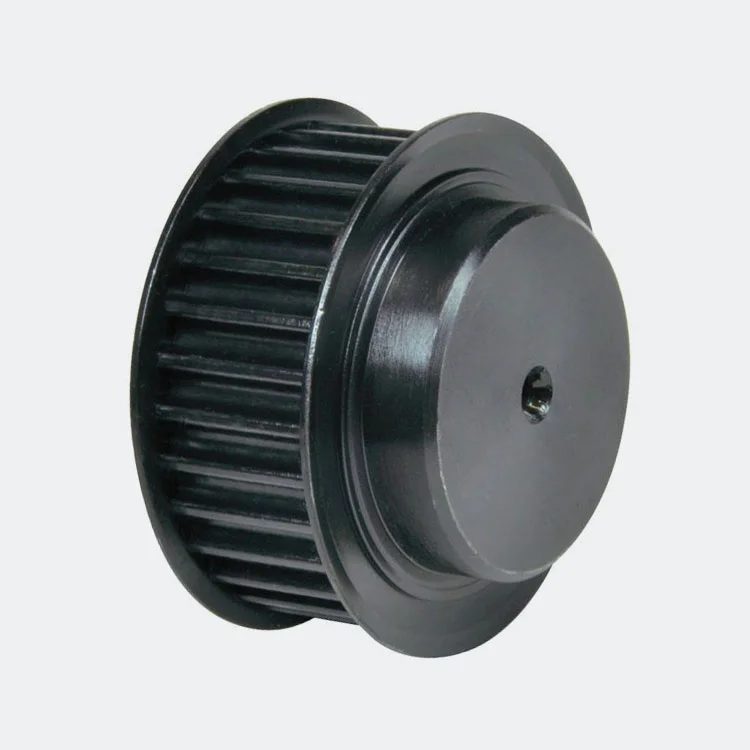
A caliper check across several teeth gives the pitch quickly, and counting teeth confirms it. Where the pulley is unmarked and worn, measure rather than assume — a 5 mm pitch pulley could be T5, AT5 or HTD 5M, and only the tooth shape distinguishes them.
Step 2 — Check Pulley Condition Before You Reuse It
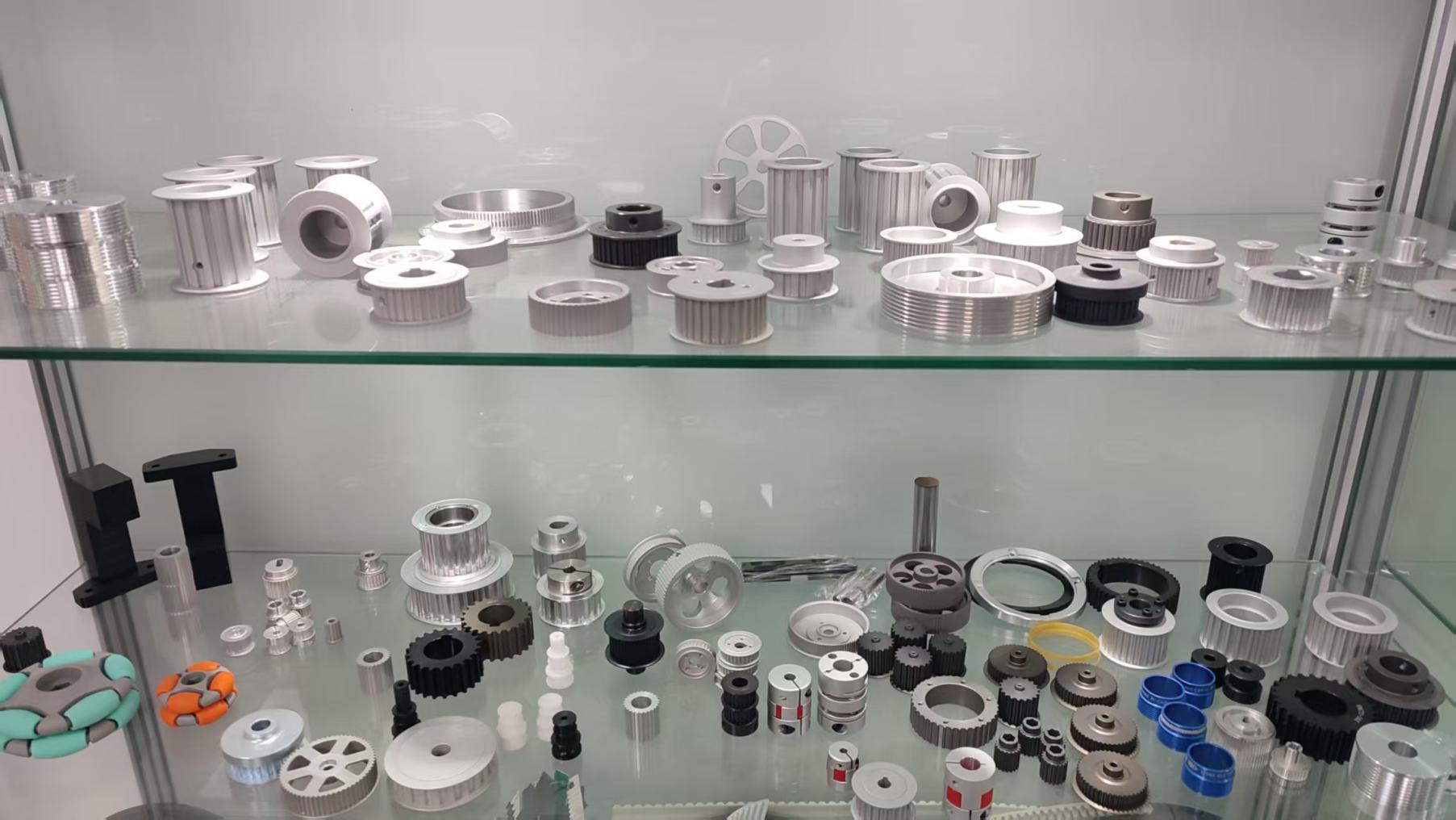
A new belt on a worn pulley will fail early, so the second step is a condition check against the pulley's own tolerance data. For both the T Series and Imperial ranges, the published values are: radial runout ≤0.03 mm, bore tolerance H7 on finished bores, maximum operating speed up to 8,000 rpm, operating temperature −30 °C to +120 °C, tooth accuracy to ISO 13050 / DIN for the T Series, and 100% dimensional inspection before shipment.
Practically, that means checking three things on the machine: runout at the pulley face (a dial indicator reading beyond the stated limit points to a bent shaft or a damaged pulley), bore and keyway condition, and tooth-flank wear. Materials and finishes in the range include aluminium alloy, carbon steel, stainless steel and cast iron, with natural, black oxide, zinc plated, hard anodized and nickel plated finishes; if the original pulley is corroding in a washdown area, correcting the finish is part of the retrofit, not a separate project. Bore diameters from 3 mm to 100 mm and tooth counts from 10 to 120 are available, with pilot, finished, taper and keyway bore types, single/double hub and flanged or unflanged configurations.
Step 3 — Fix the Belt Envelope: Pitch Length, Width and Thickness
With the pulley confirmed, the belt is defined by three dimensions plus a tolerance band. The tolerances in the supplied data are consistent across most profiles — width ±0.5 mm, length ±0.5 mm, thickness ±0.2 mm — with two exceptions worth noting: T5 PU lists a thickness tolerance of ±0.15 mm, and HTD 14M widens to ±1.0 mm on width and ±0.4 mm on thickness.
Those figures tell you how much take-up adjustment the conveyor frame must provide. If the existing frame has a fixed centre distance and no tensioner, a belt at the top of the length tolerance band may not tension correctly; in that case the length should be specified with the supplier rather than ordered at nominal. Customization in the range covers belt length, width, tooth profile, pitch, material, tensile cord (fibreglass, Kevlar or steel), coating, colour, perforation and logo printing, which is what makes a non-standard centre distance workable.
Step 4 — Match the Profile Family: HTD, T or AT
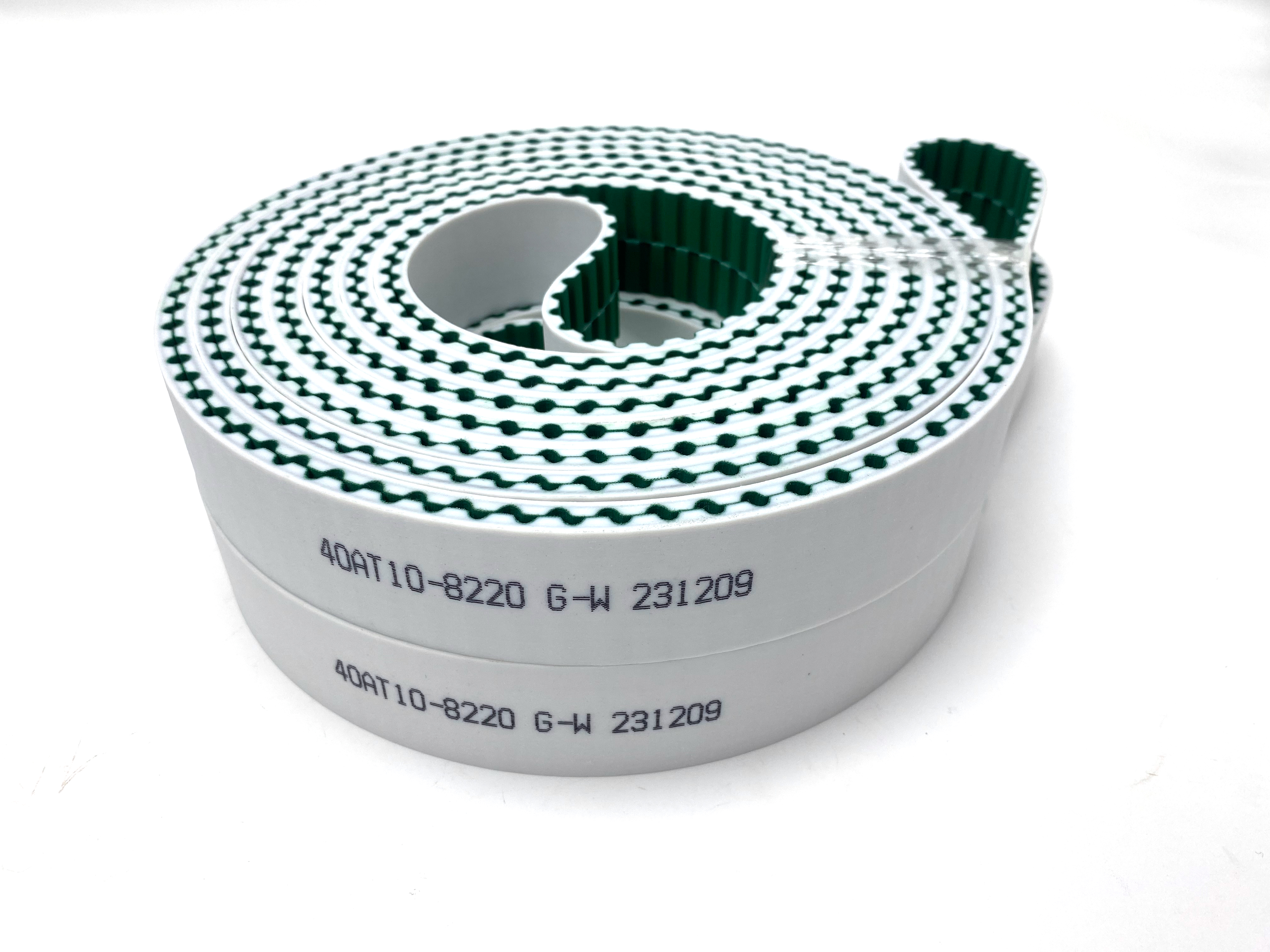
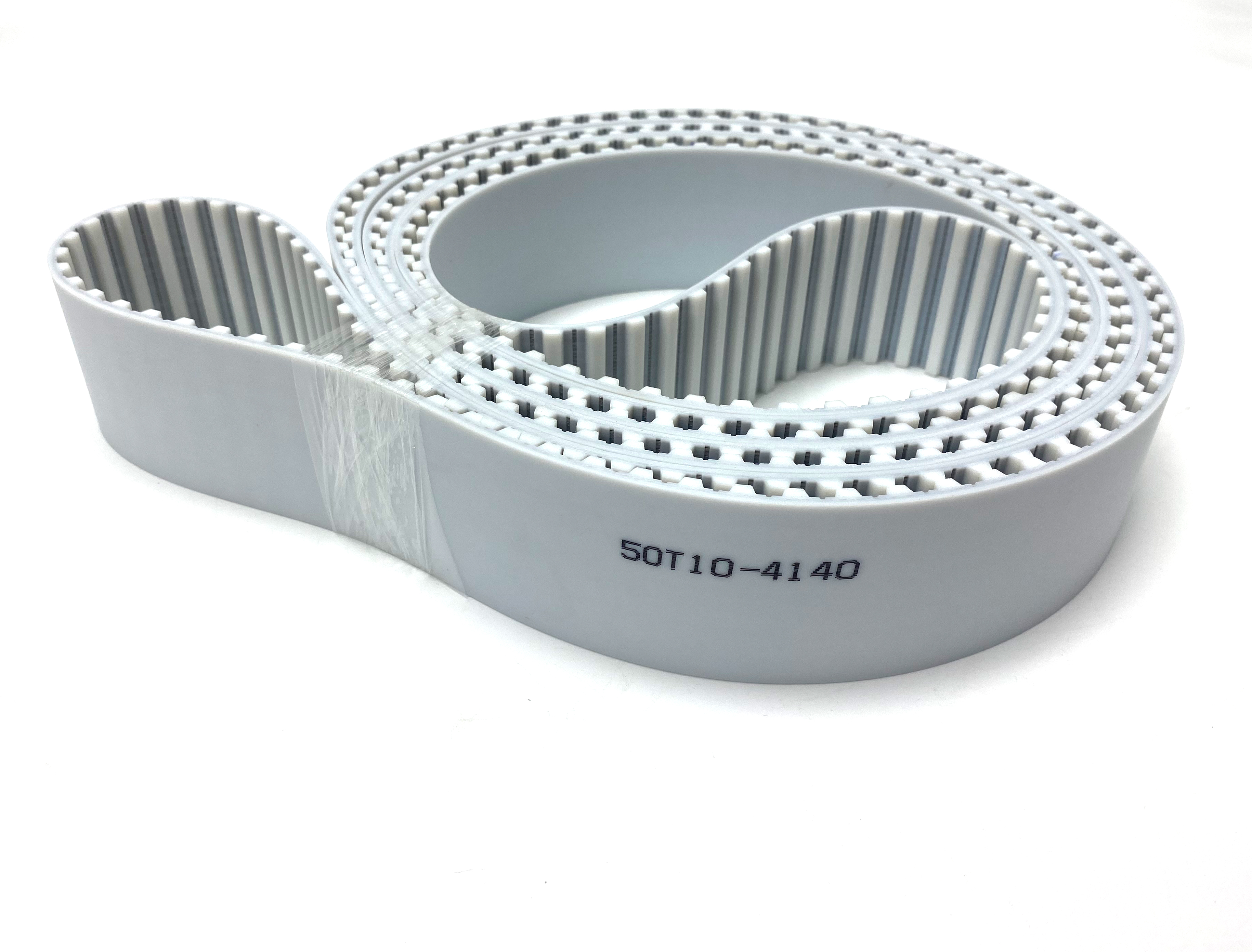
If the pulleys stay, the profile family is already decided by the pulley. If the retrofit includes new pulleys, the family decision comes down to two hard constraints: the smallest pulley diameter the drive can accept, and the allowable tensile load the belt must carry. The supplied data makes both constraints explicit.
Same pitch, different load capability
At a 5 mm pitch, T5 PU lists a minimum pulley diameter of 30.0 mm, a maximum allowable tensile strength of 393 N per 10 mm of belt width and power transmission up to 5 kW. AT5 PU lists a smaller minimum pulley diameter of 25.0 mm, an overall thickness of 2.7 mm against 2.2 mm for T5, and power transmission up to 15 kW. At a 10 mm pitch the gap is wider: T10 PU is listed at 780 N per 10 mm and up to 30 kW with a 60.0 mm minimum pulley, while AT10 PU is listed at 1,700 N per 10 mm and up to 70 kW with a 50.0 mm minimum pulley.
Read that as a documented capability difference within this product range, not as a universal rule about profile families. It does mean that a conveyor drive short on load margin at T10 has an in-range alternative at AT10 without changing pitch — provided the pulleys are changed to match the AT tooth form.
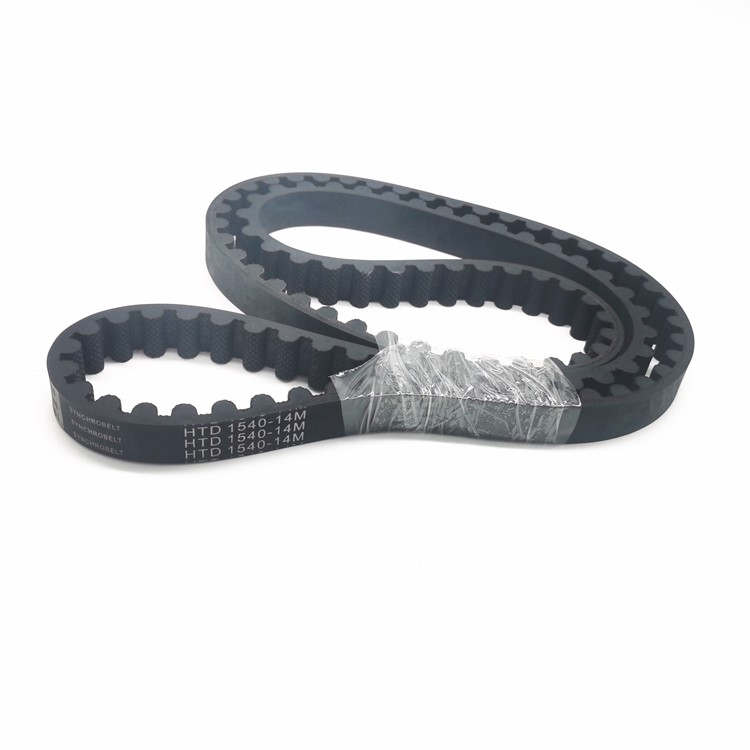
The curvilinear HTD family follows a different logic. HTD 5M, 8M and 14M are listed with minimum pulley teeth of 16, 16 and 28 respectively, and minimum pulley diameters of 25 mm, 40 mm and 124.78 mm. HTD 14M is therefore not an option on a conveyor with a small head pulley, whatever its load advantage: the listed ultimate tensile strength of 8,308 N per 10 mm width is only usable if the pulley geometry supports the profile.
Step 5 — Choose the Body Material: PU, Rubber or Carbon-Reinforced
Material choice is the second half of the decision and is often the more visible one to maintenance teams, because belt life on a conveyor tends to be judged by the body rather than the tooth. The supplied data supports three routes.
Polyurethane (PU) timing belts
The PU belts in the range use a polyurethane body at 92 Shore A with a steel cord tensile member across the AT and T profiles quoted here. Documented values include AT5 (5.0 mm pitch, 2.7 mm thickness, 25.0 mm minimum pulley, up to 15 kW, approximately 10,000 rpm), AT10 (10.0 mm pitch, 4.5 mm thickness, 50.0 mm minimum pulley, 1,700 N per 10 mm, up to 70 kW), T5 (5.0 mm pitch, 2.2 mm thickness, 30.0 mm minimum pulley, 393 N per 10 mm, up to 5 kW) and T10 (10.0 mm pitch, 4.5 mm thickness, 60.0 mm minimum pulley, 780 N per 10 mm, up to 30 kW). All four are listed with a maximum rotational speed of approximately 10,000 rpm.
Rubber timing belts
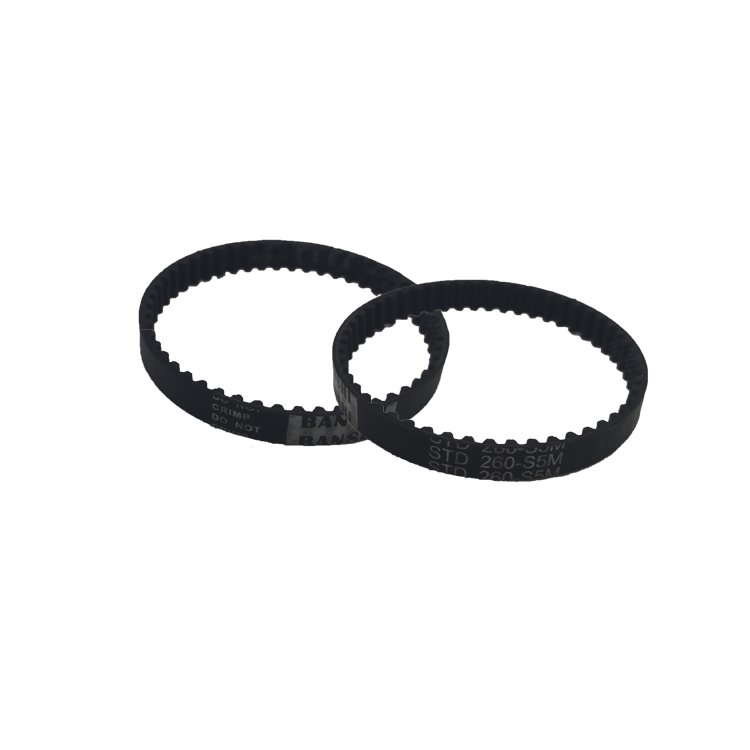
The rubber belts in the range use a neoprene (CR) body at 92 Shore A with a fibreglass cord. HTD 5M is listed at 3.6 mm overall thickness, 650 N per 10 mm maximum allowable tensile strength and 2,600 N per 10 mm ultimate tensile strength; HTD 8M at 5.6 mm, 780 N and 3,120 N; HTD 14M at 10.0 mm, 1,816 N and 8,308 N. The STD range adds an S5M profile (designated STS/STPD S5M) at 3.4 mm thickness, 22.3 mm minimum pulley diameter, 300 N per 10 mm allowable and 1,200 N per 10 mm ultimate tensile strength. A 2026 commercial market study cited in the supplied research places rubber-based belts as the volume-leading material segment on durability and cost balance — useful context, but it is a segment-level market observation, not a recommendation for a specific conveyor.
POLYCHIAN GT carbon timing belt
The POLYCHIAN GT carbon timing belt (8MGT designation) is part of the same product range and appears in the supplied application data among the belts matched to automation scenarios described as high-speed, continuous operation with high positioning precision and low noise. Unlike the AT, T, HTD and STD models above, no pitch, thickness or tensile figures are supplied for this model, so a retrofit should request the item-level data sheet and confirm the pulley match before ordering. Do not carry over an allowable tensile figure from an 8M HTD rubber belt to an 8MGT carbon belt by assumption — the designations are different and the numbers must come from the supplier.
Step 6 — Order, Install and Re-Check
The final step turns the specification into a delivered part. A complete replacement request for a conveyor drive should carry: pulley family and pitch, tooth count and bore, belt profile and pitch, pitch length and width, body material and cord type, quantity, and the standard or drawing the item must meet. Adding the drive's operating conditions — continuous or intermittent, ambient temperature, washdown or oil exposure, and whether an antistatic belt is required under ISO 1813 — closes the gaps that otherwise reappear as a clarification round.
On the supply side, the capability data for the Zhende range lists OEM/ODM production with a monthly capacity of 100,000 pulleys and 500,000 belts, a listed lead time of 7–20 days, a minimum order of 4 pcs for belts, 10 pcs for standard pulleys and 50 pcs for customized pulleys, and quality control that includes 100% dimensional inspection, tensile strength testing, tooth profile inspection and pre-shipment inspection with third-party (SGS) inspection available. The company separately reports that regular models can ship within 3 days from a warehouse holding over one million standard items — a stock-service claim that applies to standard items, distinct from the 7–20 day figure for OEM and customized production.
Installation is where most of the remaining risk sits. Confirm that the belt seats fully into the tooth cavities before tensioning, check pulley alignment across the belt width, and re-check tension after the first run-in period. Technical selection support and installation guidance are listed among the after-sales services in the supplied capability data, which is worth using when a retrofit changes profile family rather than simply renewing the same part.
Documented Specification Comparison
The table below reproduces the values published in the supplied product data so that profiles can be compared on identical fields. Read it as a data sheet extract, not as a ranking.
| Profile | Body / cord | Pitch | Overall thickness | Min. pulley diameter | Max. allowable tensile (per 10 mm width) | Listed power / speed |
|---|---|---|---|---|---|---|
| AT5 PU | PU / steel | 5.0 mm | 2.7 mm | 25.0 mm | 700 (unit not stated in this sheet) | ≤ 15 kW; approx. 10,000 rpm |
| T5 PU | PU / steel | 5.0 mm | 2.2 mm | 30.0 mm | 393 N | ≤ 5 kW; approx. 10,000 rpm |
| AT10 PU | PU / steel | 10.0 mm | 4.5 mm | 50.0 mm | 1,700 N | ≤ 70 kW; approx. 10,000 rpm |
| T10 PU | PU / steel | 10.0 mm | 4.5 mm | 60.0 mm | 780 N | ≤ 30 kW; approx. 10,000 rpm |
| HTD 5M | CR rubber / fibreglass | 5.0 mm | 3.6 mm | 25 mm (min. 16 teeth) | 650 N (ultimate 2,600 N) | — |
| HTD 8M | CR rubber / fibreglass | 8.0 mm | 5.6 mm | 40 mm (min. 16 teeth) | 780 N (ultimate 3,120 N) | — |
| HTD 14M | CR rubber / fibreglass | 14.0 mm | 10.0 mm | 124.78 mm (min. 28 teeth) | 1,816 N (ultimate 8,308 N) | — |
| S5M (STD) | CR rubber / fibreglass | 5.0 mm | 3.4 mm | 22.3 mm | 300 N (ultimate 1,200 N) | — |
Note on the AT5 row: the supplied AT5 sheet lists a maximum allowable tensile strength of 700 without stating a unit, while the AT10, T5, T10 and HTD sheets state N per 10 mm of belt width. Confirm the basis with the supplier before comparing the AT5 figure directly with the others.
Where Each Configuration Fits on a Conveyor
Profile and material choices map onto recognisable conveyor situations. These are application patterns, not guarantees of performance on a specific machine.
- Small-pulley indexing conveyors. Where the drive uses a pulley below 40 mm, the curvilinear 8M and 14M options are excluded by their minimum pulley diameters. T5 PU or AT5 PU at a 5 mm pitch fits this geometry, and AT5 is the in-range option when more power must pass through the same pitch.
- Medium-duty packaging and labelling lines. T10 PU and HTD 8M both sit in this band. The choice usually follows the pulleys already fitted: a trapezoidal pulley takes T10, a curvilinear pulley takes 8M.
- High-load material handling. HTD 14M is listed at 8,308 N per 10 mm ultimate tensile strength, but only with a pulley of 28 teeth or more and at least 124.78 mm diameter; it is a large-pulley solution.
- Precision positioning on CNC, robotics and linear modules. The supplied application data pairs PU and rubber belts with servo-driven, high-precision scenarios requiring high concentricity and a precision-machined tooth profile, with custom bore, keyway and flange options on the pulley side.
- Food processing and washdown areas. Material compliance drives the choice as much as load does; confirm the food-contact documentation for the specific material before ordering.
The supplied project records describe two OEM programmes — one in Germany over five years and one in the United States over three years — covering automated production lines, packaging equipment and CNC machinery, with company-reported outcomes including improved transmission accuracy, reduced maintenance cost and reduced downtime. Those are supplier-reported programme results for those projects; they are not a performance prediction for a different conveyor.
Limitations and What the Datasheets Do Not Cover
A specification sheet is a starting point, and several things needed for a retrofit decision are simply not in it. Be explicit about these when you raise the request:
- Service life under your load. Allowable and ultimate tensile strengths are not a life prediction. Belt life depends on actual torque, pulley size, tension, alignment and duty cycle, none of which the catalogue knows.
- Operating temperature of the belt body. The pulley data lists −30 °C to +120 °C, which is a pulley figure. Belt-body temperature limits are not stated in the supplied belt sheets and should be obtained for the exact model.
- Standard coverage of HTD and GT designations. Confirm which document governs the tooth geometry before accepting a cross-supplier substitution.
- Chemical and food-contact compliance by material. REACH applies generally to articles on the EU market, RoHS only in the electrical/electronic context, and 21 CFR 177.2600 only to rubber in repeated food contact. Request the document that matches your material and destination.
- Pulley-side data for AT and HTD pulleys. Parameter sheets in the supplied data cover T Series and Imperial pulleys; for AT or HTD pulleys, obtain the drawing.
Frequently Asked Questions
How do I identify the belt profile on an existing conveyor drive before ordering a replacement?
Read the pulley, not the old belt. Note the tooth shape (trapezoidal or curvilinear), the pitch, the tooth count and the running width. Pitch comes from a caliper measurement across several teeth and is confirmed by counting teeth. Be careful with 5 mm pitch: T5, AT5 and HTD 5M all use 5 mm, but they differ in tooth form, belt thickness and minimum pulley diameter (30.0 mm, 25.0 mm and 25 mm respectively in the supplied data), so pitch alone does not identify the belt. If the pulley is unmarked, measure it or obtain the drawing.
Do I have to replace the pulleys when I replace the belt?
Not always, but the check is not optional. If the existing pulley matches the profile and pitch, shows radial runout within 0.03 mm, and has sound bore and tooth flanks, it can be reused. If you change profile family — for example from T10 to AT10 to gain allowable tensile strength — the pulleys must change with the belt, because the tooth form and the minimum pulley diameter differ. Reusing a worn pulley with a new belt typically costs more than replacing both.
Should I choose PU or rubber for a conveyor drive replacement?
Start from what the drive already uses and what the load requires. In the supplied data, PU belts use a 92 Shore A polyurethane body with a steel cord and reach up to 70 kW at AT10 (1,700 N per 10 mm allowable tensile strength). Rubber belts use a neoprene (CR) body with a fibreglass cord, with HTD 14M listed at 1,816 N per 10 mm allowable and 8,308 N ultimate tensile strength, and are the volume-leading material segment in a 2026 commercial market study. Where food contact applies, the compliance route differs between rubber and PU, so material choice and compliance choice must be made together.
custom size timing belt manufacturer for OEM projects Chinese
Qualify the manufacturer on four documents rather than on a product list: the drawing or standard governing the tooth geometry, the item-level data sheet for the exact profile and material, the inspection record (the Zhende range lists 100% dimensional inspection, tensile strength testing and tooth profile inspection, with third-party SGS inspection available), and the commercial terms. Dongguan Zhende Machinery Equipment Co., LTD is a manufacturer and one-stop procurement provider of FA automation transmission parts that offers OEM/ODM customization across belt length, width, tooth profile, pitch, material, cord type, coating and perforation, with a listed monthly capacity of 500,000 belts and 100,000 pulleys and a 7–20 day OEM lead time. For a retrofit, send the pulley data with the request so the belt is quoted against the installed geometry.
What are the minimum order quantities, lead times and sample options for a replacement order?
The supplied capability data lists a minimum order of 4 pcs for belts, 10 pcs for standard pulleys and 50 pcs for customized pulleys, with a 7–20 day lead time for OEM and customized production; the company separately reports that regular standard models can ship within 3 days from stock. Sample evaluation is a normal qualification step for a retrofit where the profile family is changing, and availability should be confirmed for the exact profile, pitch length and material rather than assumed. The listed after-sales scope includes technical selection support and installation guidance, and replacement for manufacturing defects within the warranty period.
Conclusion: Pulley First, Then Belt
A conveyor retrofit goes smoothly when the sequence is respected: read the installed pulley and its pitch, verify runout, bore and tooth condition against the 0.03 mm and H7 figures, fix the belt envelope with its tolerance band, then choose the profile family and body material against the smallest pulley the drive can accept and the allowable tensile load the belt must carry. PU, rubber and the POLYCHIAN GT carbon timing belt are not interchangeable defaults — they are options whose item-level data must be confirmed for the exact replacement.
The full product and specification range is documented in the Zhende catalogue, which can be downloaded here: Zhende product catalogue (PDF). For a specific conveyor drive, the fastest route to a correct part is to send the pulley details and operating conditions to the supplier and ask for the belt data sheet that matches them.
Replacing belts on an existing conveyor drive?
Share the pulley profile, tooth count, pitch length and width with Dongguan Zhende Machinery Equipment Co., LTD to confirm the matching belt data sheet, sample availability and delivery schedule before the line goes down.
Have Questions or Need More Details?
Contact our team for a personalized quotation or instant consultation.
Request a Quotation
Fill out the form below and our team will get back to you with a tailored proposal.
WhatsApp Direct Chat
Prefer to chat in real-time? Message us on WhatsApp for instant assistance & quick answers.
- Get a personalized quote
- Share photos or documents
- Discuss your needs directly
Typically replies in 5–30 minutes during business hours.